Space and Setup Requirements for Wooden Gym Toys
- Share
- publisher
- Green Forest Toys & Gifts CO.,Ltd
- Issue Time
- Dec 3,2024
Summary
Wooden gym toys are a favorite choice for parents seeking safe, engaging, and developmentally enriching play equipment for their children.
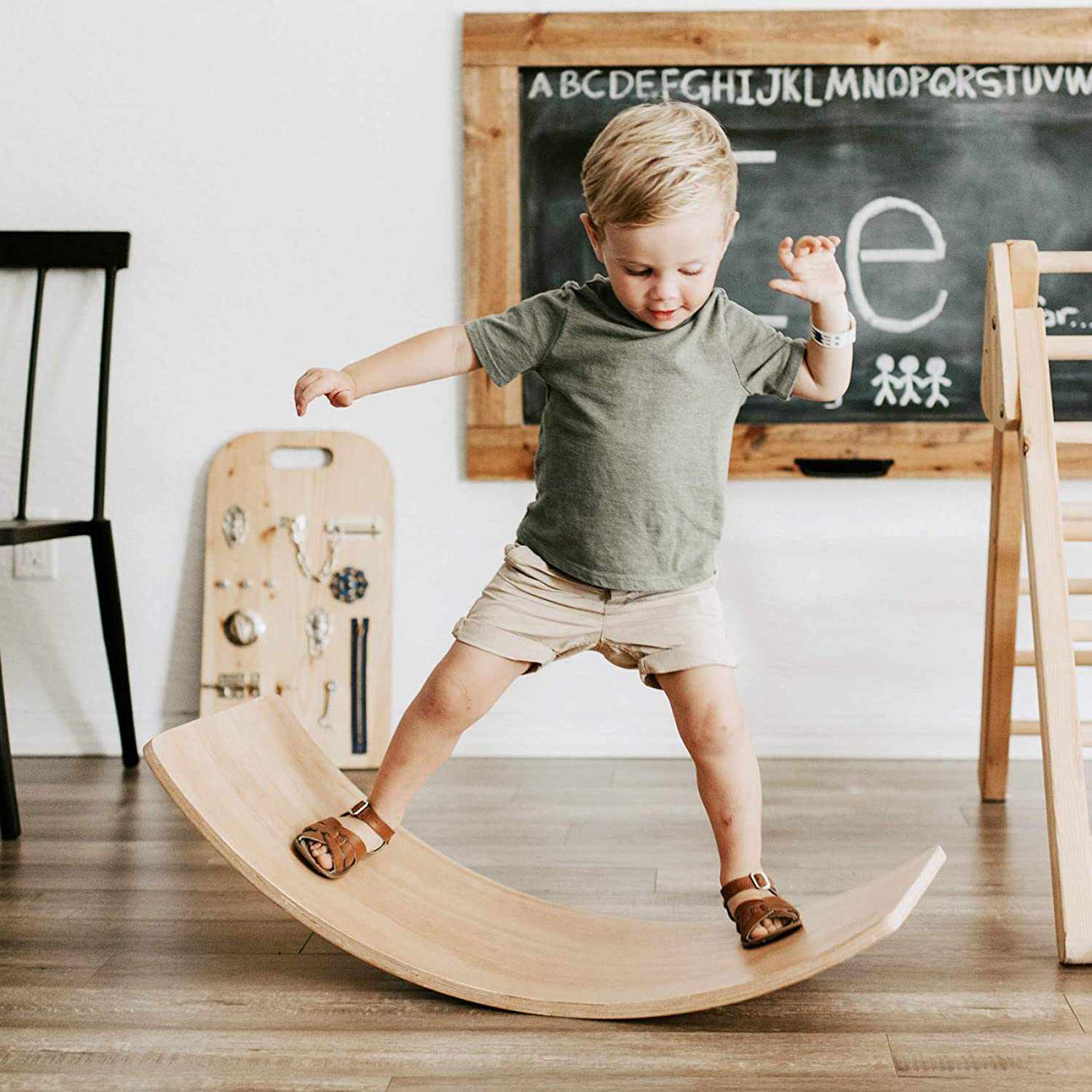
Space and Setup Requirements for Wooden Gym Toys: A Practical Planning Guide
A climbing triangle is a wonderful developmental tool and a genuinely large piece of furniture, and that second fact decides more purchases than parents expect. The most common reason a beautiful wooden gym toy ends up unused is not boredom but logistics: it does not fit the room, it blocks a doorway when unfolded, or assembly turned into an evening project nobody wants to repeat.
This guide removes the guesswork. It walks through real space footprints with square metres and clearances, floor and mat choices, what assembly actually involves, folding and storage strategies for small homes, and how to place a frame so it gets used every day instead of hiding in a corner. The advice comes from manufacturing experience: as a wooden toy factory supplying active-play brands since 2003, Forestoy designs folding mechanisms and flat-pack packaging for exactly these real-world constraints.
- Real floor footprints and clearance zones, in numbers
- How to choose floor surfaces, mats and room placement
- What assembly involves and how folding designs change the maths
- Storage strategies for apartments and shared rooms
- What brands should specify so products suit small-space living

Plan the footprint plus a buffer. A foldable climbing triangle typically measures about 90 × 85 cm and needs roughly 1.5 square metres including clearance; an arch rocker about 1.2 square metres; a balance beam or stepping-stone course 2 to 3 square metres; and a multi-piece gym setup 3 to 4 square metres. Keep at least 50 cm of clear space around any climbing structure, place it away from hard furniture corners and windows, and put it on a non-slip surface or activity mat. Folding designs collapse to 15 to 20 cm deep and slide under a bed or behind a door, which is why they dominate small-home assortments.
The mistake most first-time buyers make is measuring only the toy. What you actually need is the footprint plus the movement zone, because a child climbing off a frame travels further than the frame itself.
| Product Type | Typical Footprint | Recommended Play Area |
|---|---|---|
| Foldable climbing triangle | ≈ 90 × 85 cm | 1.5 m² with 50 cm clearance on all sides |
| Arch rocker / climber | ≈ 80 × 75 cm | 1.2 m², more if used as a rocking toy at speed |
| Balance board | ≈ 90 × 30 cm | 1 m² of open floor, 360° rocking radius |
| Balance beam + stepping stones | Configurable course | 2–3 m², stones placed 20–30 cm apart |
| Multi-piece gym (triangle + arch + ramp) | ≈ 2.0 × 1.2 m | 3–4 m² including approach space |
| Learning tower | ≈ 50 × 50 cm | 0.5 m² at counter height, no climb-over clearance needed |
Three measuring habits prevent almost every bad purchase. First, mark the footprint on the floor with tape and walk around it, checking doors, radiators and walking routes. Second, look up, not just out, some designs need headroom for standing play on top. Third, respect the 50 cm clearance rule from paediatric physiotherapy practice: it is what turns a fall from an impact into a stumble. The full wooden indoor gym toy collection lists dimensions for every model, so the numbers above can be checked against specific products.
Where the frame stands matters as much as how much room it has. A good setup pairs a stable floor with a forgiving surface around, not under, the climbing zone.
- Place the structure on a non-slip surface. On hard floors use a rubber-backed activity mat (1–2 cm is enough for climbing frames; gymnastic mats suit older jumpers).
- On carpet, choose a low-pile area rug rather than thick foam tiles, which compress unevenly under a loaded frame's feet.
- Keep 1 metre or more from hard furniture corners, glass, radiators and windows with low sills.
- Keep the zone inside the parent's line of sight from the kitchen or desk, supervision works by sightline, not by room name.
- Check that the frame sits level; adjustable feet or a thin shim fix minor floor unevenness before it becomes a wobble.
Setup choices interact with safety engineering, rung spacing, tip resistance and load ratings are designed into the product, but the room finishes the job. Both sides of that equation are covered in our guide to safety features and durability of wooden indoor gym toys.
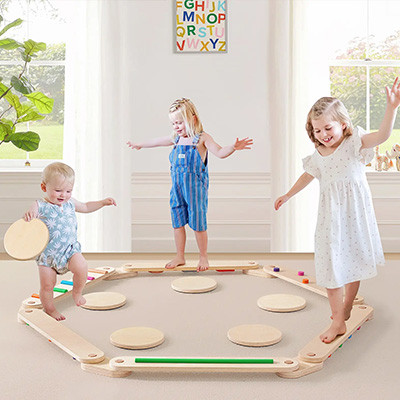
Assembly anxiety is mostly a packaging problem. A well-designed wooden gym toy should go from box to climbing in 15 to 30 minutes with basic tools.
Quality kits arrive with pre-drilled frames, pre-installed inserts, all required hex keys or an Allen wrench, and illustrated instructions with a parts checklist. No drilling, no wall fixing, the frame is self-supporting by design.
A foldable triangle unfolds and locks in under a minute after first setup. Full bolt-together frames take 15 to 30 minutes. Modular systems, cube chair, ramp, rocker, add 5 to 10 minutes per reconfiguration.
Re-check every fastener after the first week of play, then monthly. Threads settle under load cycles in any wooden structure, and a 30-second pass with the supplied key keeps joints factory-tight.
Frames that reconfigure, a ramp becoming a slide or a bridge, extend play value without new furniture. Our Pikler triangle with reversible ramp is built around that principle: one footprint, multiple setups.
For apartments and shared rooms, the buying decision is really a storage decision. Three strategies cover most situations.
Fold and slide. A foldable Pikler triangle collapses flat and stores 15 to 20 cm deep, under a bed, behind a sofa or against a wardrobe wall. Folding mechanisms should lock positively in the open position, a hinge that merely "feels" stiff is not a safety feature, which is why our folding designs use a lock that must be deliberately released.
Store vertically. Arches, ramps and beams slide into the gap beside a bookcase; balance boards lean flat against a wall or slip under a sofa. Many families dedicate one wall strip and a corner, not a whole room, to the gym.
Rotate instead of display. Montessori households often keep two or three pieces in service and rotate the rest monthly, which doubles perceived novelty without adding floor area. Smaller pieces, a wobble balance board or stacking blocks, earn permanent placement because they double as room décor between play sessions.
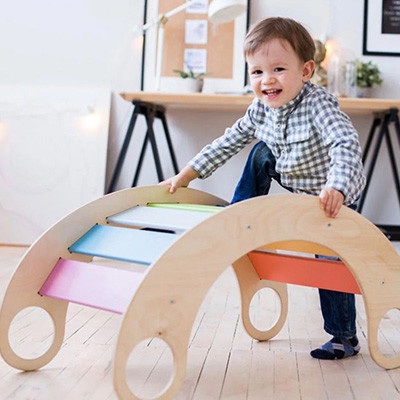
The natural wood finish is the quiet advantage of the category: it reads as furniture, not plastic clutter, which is what lets a gym share space with adult life.
The easy case: build the multi-piece setup, add a mat, and let the course grow with the child. Pairs well with low shelving so children reset the room themselves.
Foldable is the rule here. A triangle that folds after dinner and an arch climber that doubles as a bed-end rocker keep the room sleepable.
Choose pieces with clean lines and calm finishes, position them along a wall with the mat defining the play edge. A learning tower in the adjacent kitchen extends active play into daily routines.
One folding triangle plus one balance board covers the developmental range in under 2.5 square metres total storage, the minimal viable gym for a city flat.
One placement habit maximises daily use: keep the gym on the route the child already walks. A frame beside the hallway or between the living room and kitchen gets climbed ten times a day; a frame in the basement gets climbed on weekends. Visibility drives usage more than square metres do.
Space efficiency is a specification, not an accident. Retailers who merchandise active play in urban markets should require three things from a manufacturing partner: folding hardware that locks positively and survives thousands of open-close cycles, packaging that protects finishes in flat-packs thin enough for car boots and lifts, and assembly instructions that survive translation without a single ambiguous diagram.
Forestoy has engineered wooden toys since 2003 for more than 100 international brands, with over 1,500 SKUs and a production capacity of roughly 200,000 pieces per month, shipping FOB Ningbo. Folding mechanisms and modular systems are developed in-house by our design and development team, validated by safety and quality control testing against EN 71, ASTM F963 and ISO 8124, and produced at scale through our manufacturing capacity. For brand-exclusive configurations, our OEM/ODM team takes products from sketch to certified production, and an overview of all capabilities is available on request.
Two further resources help position the category: our guide to the developmental benefits of wooden gym toys supplies the "why buy" story, while the step-by-step B2B sourcing guide covers supplier selection. The complete range, gym line included, sits in the product catalogue, and everything shown on the Forestoy homepage reflects current production.
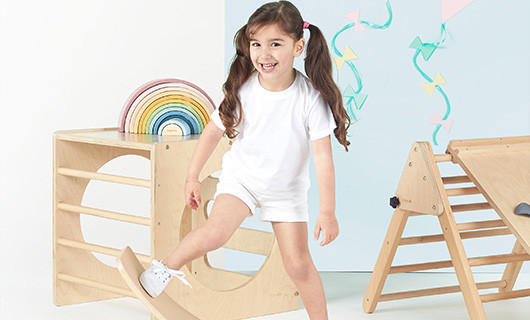
1. What is the minimum room size for a wooden climbing frame?
For a single foldable triangle, a 2 × 2 metre clear area is comfortable. A multi-piece gym is happiest in 3 to 4 square metres. Because quality designs fold flat, the storage footprint can be almost zero, so even a one-bedroom flat can host a full active-play setup.
2. Can I use a wooden gym on carpet?
Yes, on low-pile carpet or a firm area rug. Avoid thick foam tiles directly under the frame's feet, they compress unevenly and introduce wobble. If the floor is uneven, shim the frame level before first use and re-check after a week.
3. Do I need a safety mat?
On hard flooring, a 1 to 2 cm rubber-backed activity mat under and around the climbing zone is strongly recommended. It prevents the frame sliding and softens tumbles. Older children doing more acrobatic play benefit from thicker mats, as with any indoor climbing.
4. How long does assembly take?
Folding triangles are essentially pre-assembled: unfold and lock, under two minutes after the first setup. Bolt-together frames take 15 to 30 minutes with the supplied hex key. Whatever the design, re-tighten all fasteners after the first week and then monthly.
5. Where should I store the gym when not in use?
Folded flat behind a door, under a bed or upright beside a wardrobe, anywhere dry and away from heating sources. Avoid damp basements and direct sunlight on painted panels. Balance boards and beams store flat under sofas or lean in wardrobe gaps.
6. Can we develop a folding or space-saving design with Forestoy?
Yes. Folding lock mechanisms, modular systems and flat-pack-optimised packaging are core specialities, developed in-house and cycle-tested before certification. Contact our team with your market's space constraints to start the design review.
The best wooden gym setup is the one that fits the way a family actually lives: measured with clearance to spare, placed on the child's daily route, finished with a sensible mat, and folded away in seconds when the room needs to change jobs. None of that requires a big home, it requires a product designed for real floor plans and a buyer who plans the room, not just the toy.
That is how we engineer the range. Browse the Forestoy wooden indoor gym collection for foldable triangles, arches and modular sets with published dimensions.
Whether you are fitting a climber into a city flat or planning a small-space active-play range for your brand, dimensions and packaging details decide the sale. Ask our team for exact specifications, request the product catalogue, or explore custom OEM/ODM designs built around your market's homes.