Wooden Baby and Toddler Toys Manufacturer in China: A B2B Sourcing Guide
- Share
- publisher
- Forestoy
- Issue Time
- Oct 27,2026
Summary
A B2B sourcing guide to wooden baby and toddler toys from China: category economics, four product families, 0-3 safety engineering, EN 71 / ASTM F963 / CPSIA compliance, materials and finishes, sample verification protocol, and OEM/private-label development from a 20-year wooden toy manufacturer.
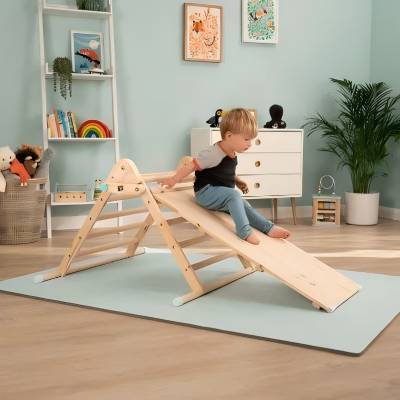
The 0–3 shelf is the hardest segment in the toy business to get right — and the most rewarding once you do. Baby and toddler products are bought on trust, regulated more tightly than any other age band, and returned ruthlessly when they fail. Choosing the right wooden baby toys manufacturer is therefore not a purchasing decision; it is a risk-management decision with a margin attached.
This guide is written for baby-product brands, retailers, distributors and e-commerce sellers evaluating a wooden toddler toys supplier in China. Rather than repeating generic supplier-checklist advice, it focuses on what actually changes when the end user is under three: the physics of weight-bearing walkers, the chemistry of mouthing, and the paperwork that separates a safe 0–3 range from a recall.
Why Wooden Baby and Toddler Toys Are a Strong Product Category
Baby and toddler toys behave differently from the rest of the toy shelf, and the numbers explain why. Statista's consumer market outlooks put the global infant and toddler toy segment in the tens of billions of US dollars a year, sustained by birth rates that never depend on a blockbuster film — but the more useful figure for a buyer is how the spend is distributed. First-time parents over-invest: the nursery category is driven by a narrow window of maximum spending anxiety between pregnancy and roughly age two, when every purchase is filtered through safety research. That filter is exactly where wooden products win share from plastic.
Three structural currents favour the wooden sub-segment. First, the under-three age band is the most compliance-intensive in the toy industry, which raises the bar for suppliers and protects manufacturers who can actually clear it — a moat, not a burden, once you have audited correctly. Second, the gift and registry channel is stable: baby-shower, christening and first-birthday gifting runs on durability and keepsake value rather than licence trends, which is why nursery retailers reorder on the same SKUs for years. Third, wood's sensory profile matches the developmental brief: weight, warmth and grain give an infant grasping toy a tactile richness that injection-moulded plastic cannot replicate at any price. A wooden baby toys supplier who can document all three currents is a partner for a range, not a vendor for a container.
Key Wooden Toy Types for Babies and Toddlers
A baby and toddler collection is built from four families, each with its own developmental claim, price point and safety profile. They are worth separating explicitly because a SKU's family determines its engineering risks — and a wooden learning toys manufacturer who cannot name those risks per family is designing by catalogue, not by age band.
Grasping and Fine-Motor Toys
Rattles, grasping beads, clutching toys and threading sets, typically 0–18 months. Everything here goes in the mouth, so the specification is unforgiving: no detachable parts, saliva-resistant finishes, radii large enough that no contour can trap a finger. The commercial appeal is high repeat-gift frequency — these are the SKUs that anchor baby-shower assortments.
Stacking and Sorting Toys
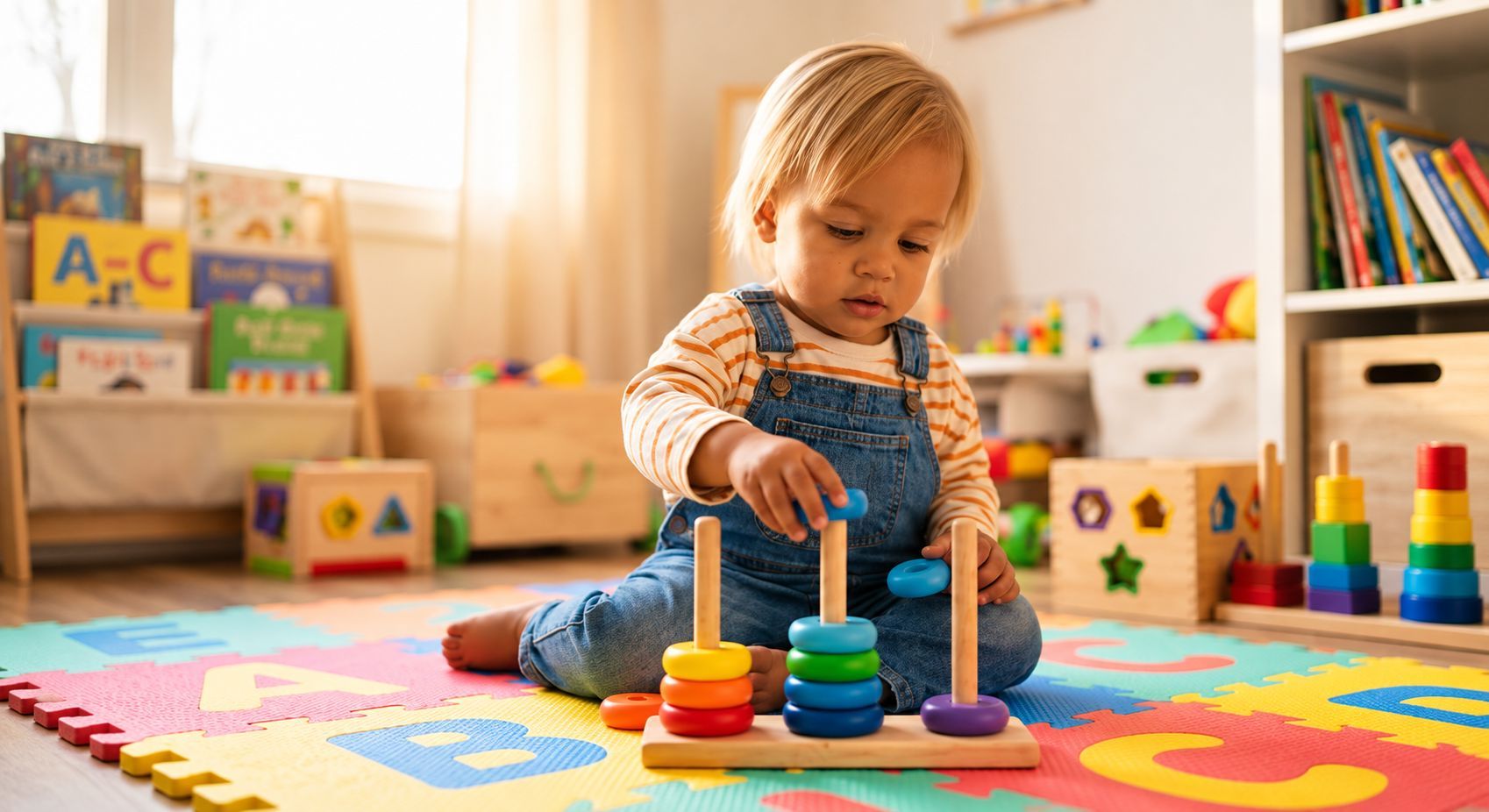
Stacking rings, nesting blocks and shape sorters, typically 12–36 months. This is the family where a toddler's frustration tolerance meets engineering head-on: an aperture that rejects a near-miss sends a two-year-old walking away, so clearances and chamfers are tuned for encouragement rather than precision. It is also the easiest developmental claim for retail copy to communicate, which is why sorting toys anchor most nursery assortments. Our activity-cube and sorter platform runs cube, drum and house formats on shared tooling, so a brand can field three looks from one certified mechanism.
Early Learning Toys
Number-puzzles, hammer benches, bead mazes and pull-alongs extend the range into the 18–36 month band with the strongest price ladder. This family sells itself at shelf: the play pattern is visible, so a parent watching a toddler post a shape or hammer a peg is watching the product demonstrate its own developmental claim — no advertising spend required.
Pretend-Play Toys
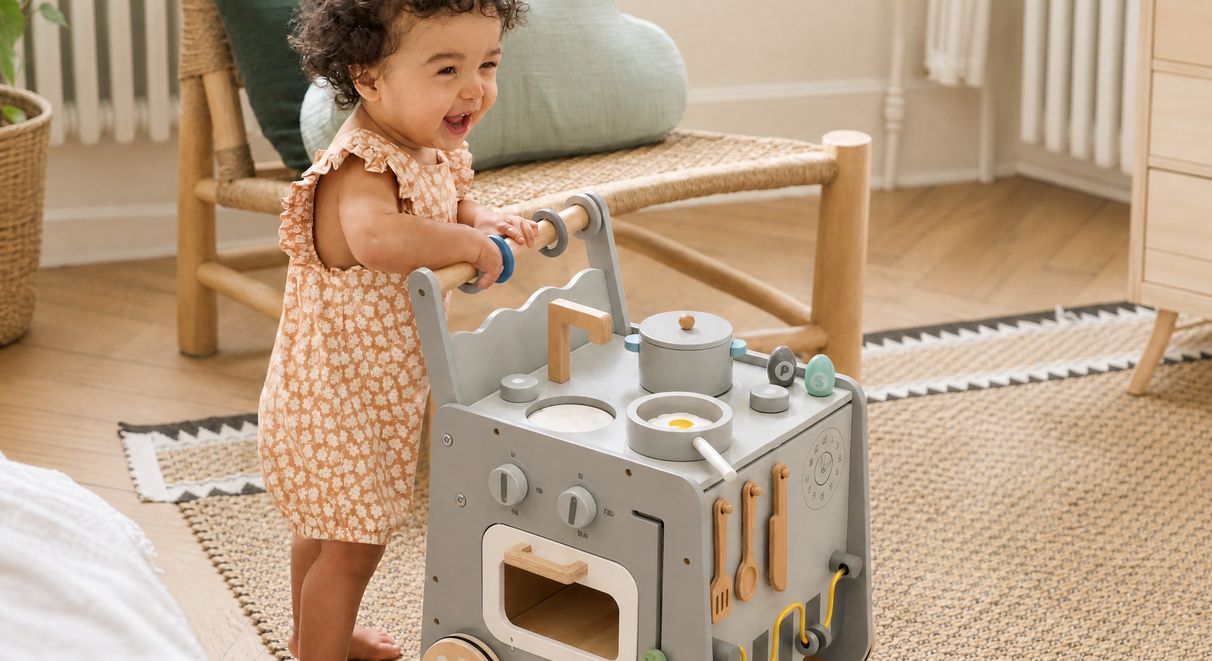
Miniature kitchens, tool benches, market stalls and push-along walkers close the toddler band and bridge into pre-school. Push walkers deserve special buyer attention: they carry a child's weight, which puts them in a different structural class — joint strength, wheel speed control and tip resistance must be engineered, not assumed. Our baby push walker platform integrates a shape sorter, bead maze and pretend-play kitchen into a single speed-controlled chassis, which is precisely the multi-SKU-per-object logic this category rewards.
Safety Considerations for Baby and Toddler Wooden Toys
Every toy must comply with its market's regulations, but the under-three band adds a second layer: the user mouths the product, cannot read a warning label, and in the case of a push walker, leans its full body weight on the chassis. Those three behaviours drive the entire safety specification, and they are where a generic wooden toy factory and a genuine baby-toy specialist part ways.
| 0–3 behaviour | Hazard it creates | Engineering response |
|---|---|---|
| Mouthing everything | Ingestion of finish chemicals; moisture damage that releases splinters | Water-based, saliva-resistant finishes; EN 71-3 migration of 19 heavy elements tested on the paint, not the substrate |
| Posting objects into mouth | Choking on small parts | 31.7 mm small-parts cylinder applied to every component before design freeze; no detachable parts below 36 months |
| Pulling, twisting, hammering | Detached knobs, wheels or pegs | Torque at 0.45 N·m and tension at 67 N on every protrusion, verified in-house on prototypes |
| Pushing body weight on walkers | Tip-over, uncontrolled speed on hard floors | Structural joint engineering, wheel-speed control and anti-tip geometry — a load-bearing spec, not a toy spec |
The regulatory wrapper around these behaviours is EN 71-1/-2/-3 under Toy Safety Directive 2009/48/EC for the EU, and ASTM F963 plus CPSIA for the US — where lead is capped at 100 ppm in substrate and 90 ppm in paint, phthalates at 0.1%, and testing must be performed by a CPSC-accepted laboratory. ISO 8124 increasingly serves Middle East and Southeast Asian distributors. The numbers are public; what separates suppliers is when they verify them. We test prototypes in-house before tooling is cut — our in-house toy testing and QC workflow exists precisely so a failure costs a revision, not a shipment.
Buyer tip: ask every candidate supplier for test reports on the actual product, not a "similar" one, and verify the report numbers with the issuing laboratory (SGS, TÜV, BV, Intertek). A report without a traceable number is marketing, not compliance.
Materials, Paints and Small-Parts Risk
Durability starts in the drying kiln: wood delivered at the wrong moisture content will crack months later, so beech and rubberwood entering our line are held to an 8–12% window — tight enough to survive a heated nursery, a monsoon-freight container and the gap between them. Every edge carries a radiused chamfer, because an infant's grip tests every contour thousands of times before the toy reaches its second owner.
Finishes follow the same discipline. Water-based, saliva-resistant paints and lacquers are the baseline for anything in the 0–3 band; solvent-based finishes have no place near a mouthing toy regardless of what a certificate says. Our custom wooden toy packaging and labelling workflow extends the same control to the box — age grading printed on pack must match the tested age range of the safety assessment, and small-parts warnings are a legal statement, not a suggestion. For the material claim on the pack itself, FSC Chain-of-Custody certification (FSC-STD-40-004) is what nursery-channel buyers increasingly verify line by line; the sourcing engineering behind it is documented on our sustainable wooden toy materials page.
Choosing a Wooden Baby Toy Manufacturer
Because the 0–3 band concentrates both the safety risk and the reputational risk, sample evaluation here should be more aggressive than for any other category. Four verification steps, in this order:
- Destroy a sample. Physically try to break the weakest joint — pull the knob, twist the wheel, soak a painted block in warm water for an hour and re-check the finish. A baby toy that survives a deliberate abuse session in your hand has been engineered for one in a toddler's.
- Trace every component. List each detachable part and check it against the 31.7 mm cylinder logic yourself. Then ask the supplier which test report covers that specific part, not just the family.
- Audit the process, not the certificate. Ask to see first-article inspection records and the AQL plan for a recent baby order. We run major 2.5 / minor 4.0 with QC checks at three stages of every order at no extra cost, and every serious wooden toddler toys supplier should produce equivalent records without hesitation.
- Check the development bench. Look at the engineering team and prototype capability behind the sample. The equipment that matters — four production workshops, an in-house laboratory and a twelve-stage line — is itemised with photos on our wooden toy manufacturing capacity page, and the stage-gate route from brief to golden sample is documented in our product development workflow.
Notice what is absent from this sequence: any reliance on the supplier's website badge wall. ISO 9001 and amfori BSCI registration are necessary hygiene factors in European retail onboarding, but they are table stakes — the differentiation in the 0–3 band lives in the sample, the traceability and the process records.
OEM and Private-Label Opportunities
Baby and toddler is the one toy category where private label carries the least discount risk, because parents buy it on trust rather than price comparison — which makes customisation unusually valuable here. The practical question is which route fits your stage. An established nursery retailer usually enters through private label on proven platforms: you select from existing walker, sorter and grasping-toy systems, we apply your brand colours, logo and packaging, and you reach shelf in weeks with certified products and minimal development spend. A brand building differentiation takes the OEM route: your design brief, engineered and tested to your exclusive specification, with the safety file and tooling owned in your name — slower to start, but the product cannot be shopped against.
The baby band also rewards set-based development more than any other category. New parents buy in journeys — grasping set, stacking set, walker, first puzzles — so brands that plan these as coordinated ranges with shared finish specs and one packaging system routinely lift basket size by a third or more versus single-SKU launches. Our packaging team structures such multi-SKU programmes regularly, from coordinated gift sets through to barcode and compliance label artwork for each market. A first sample typically reaches the buyer within ten working days of design sign-off; a fuller comparison of the development models is in our OEM vs ODM wooden toys guide, and the retail-brand build-out is covered in our private label wooden toys guide.
Forestoy's Quality and Compliance Approach
Forestoy has spent more than two decades manufacturing wooden toys and children's furniture for brands across Europe, North America and Asia, and the baby and toddler band has been part of that work since the beginning. What that looks like in practice for a 0–3 programme: walkers engineered as load-bearing furniture — joint strength, wheel-speed control and tip geometry reviewed at drawing stage, not discovered at inspection. A finish line dedicated to water-based, saliva-resistant coatings, with migration screening on every colourway rather than one representative sample. Prototypes subjected to the full 0.45 N·m torque and 67 N tension battery in our own laboratory before a single cutting tool is ordered. And when a range needs to extend upward, our learning tower and Montessori furniture range picks up exactly where the toddler band ends — the wider assortment is browsable in our wooden educational toys collection.
For buyers mapping the surrounding landscape, our Montessori wooden toy manufacturer guide details the material standards behind the 12–36 month band, and our educational wooden toys guide covers how the collection extends into pre-school.
Build a Baby and Toddler Wooden Toy Collection
Baby and toddler buyers are audited by their customers more than any other toy category — a recalled infant product can end a nursery brand. We make that risk ours to carry, not yours. Three ways to begin:
- Get the factory audit pack — certifications, third-party test reports, QC workflow and AQL standards for your compliance file, before you commit a single sample fee.
- Request a baby and toddler sample set — hero SKUs from each family, so your buyers judge the finish, weight and joint quality first-hand.
- Start an OEM/ODM consultation — send your drawings, references or product brief and receive a development plan with tooling costs and lead times.
Standards and Sources Referenced
- EN 71-1, EN 71-2 and EN 71-3 under EU Toy Safety Directive 2009/48/EC; 31.7 mm small-parts cylinder; torque 0.45 N·m and tension 67 N requirements.
- ASTM F963 (mandatory under 16 CFR 1250); CPSIA lead limits (100 ppm substrate / 90 ppm paint) and phthalate limits (0.1%); ISO 8124 for third markets.
- FSC Chain-of-Custody Standard FSC-STD-40-004; ISO 9001 quality management; amfori BSCI social compliance.
- Global toy market estimates and infant/toddler category trends from Statista and Circana annual industry reviews.