Role-Playing Adventures with Wooden Pretend Toys: Sparking Imagination Through Play
- Share
- publisher
- Green Forest Toys & Gifts CO.,Ltd
- Issue Time
- Nov 30,2024
Summary
Wooden pretend toys, whether crafted as miniature kitchen sets, tool kits, or dollhouses, are much more than playthings—they are tools for creativity and growth.
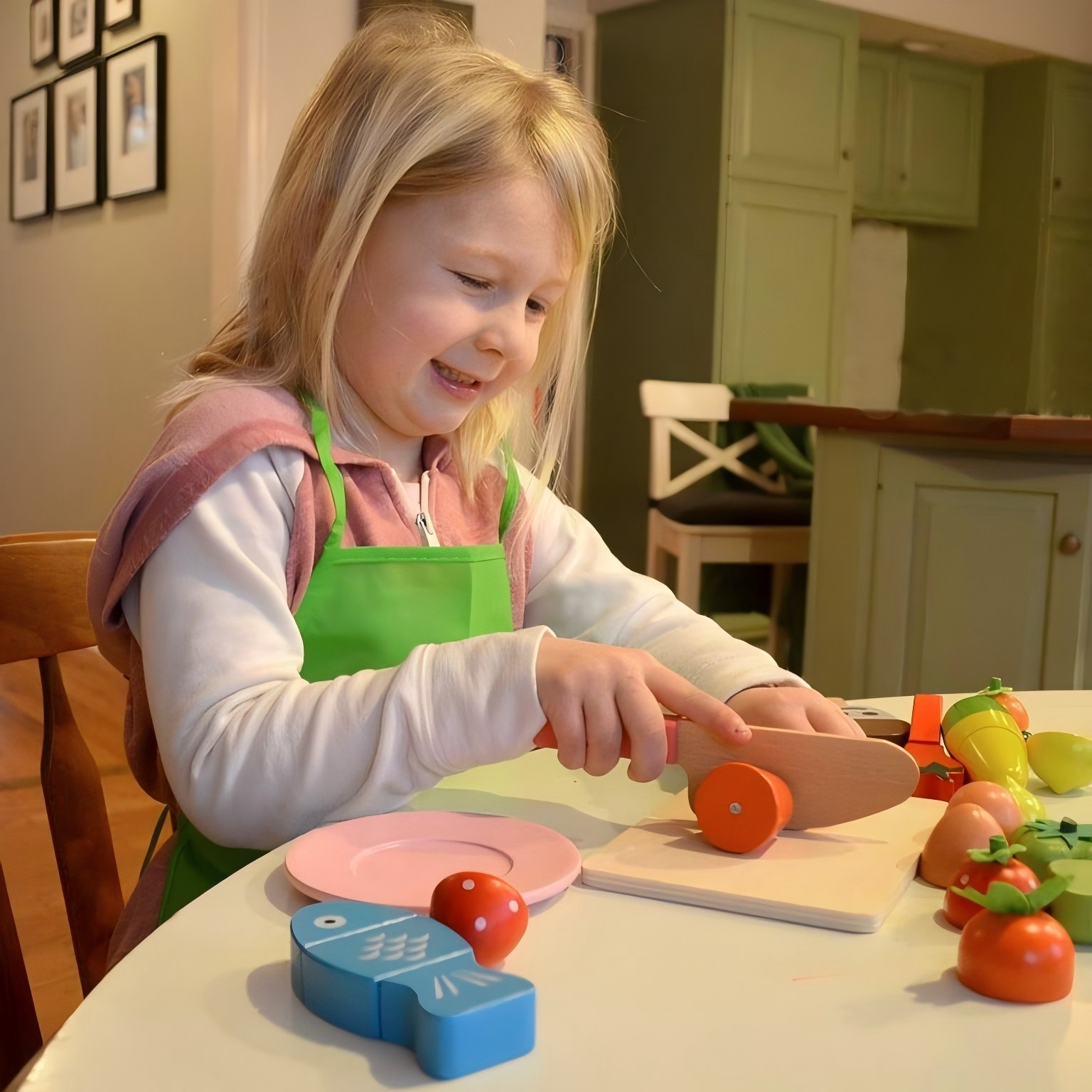
Forestoy Insights · Pretend Play
Wooden pretend toys hold a timeless charm, captivating children and adults alike with their simplicity and versatility. Whether crafted as miniature kitchen sets, tool kits, or dollhouses, they are much more than playthings — they are tools for creativity and growth. Through role-playing adventures, wooden pretend toys spark imagination and nurture the developmental skills children carry into every later stage of life. In this guide, the team at FORESTOY explores why pretend play matters so much, what happens developmentally while children play, and how to choose wooden role-play toys that families will treasure for years.
1. Why Wooden Pretend Toys Hold a Timeless Charm
Fashions in toys come and go, yet wooden pretend toys have stayed in children's hands for generations. The reason is not nostalgia — it is design. A wooden play set offers simplicity and versatility in equal measure: it does not beep, flash, or prescribe what a child should do, so the child must supply the story. That single design decision is what makes a wooden kitchen set, a wooden tool kit, or a wooden dollhouse so endlessly replayable.
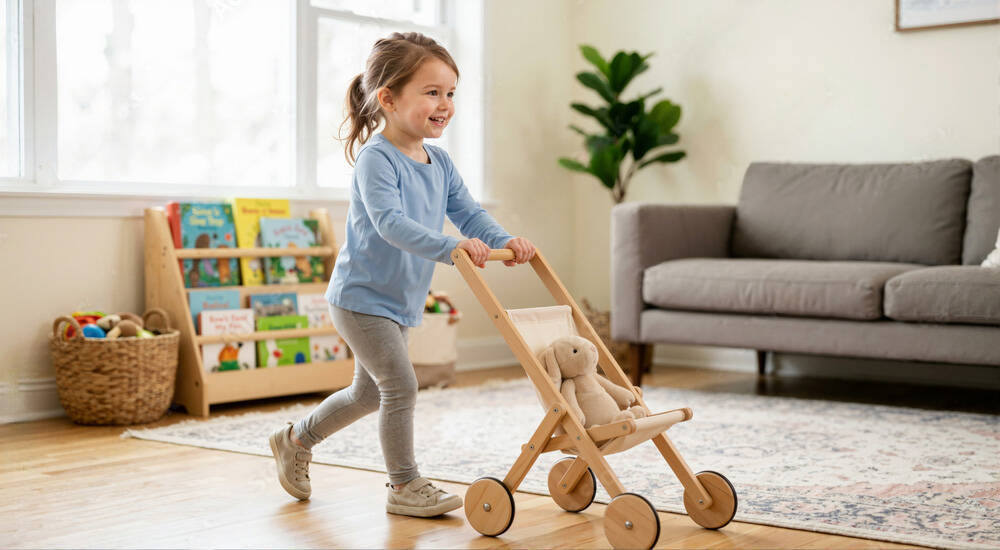
Child-development specialists describe pretend play as the highest form of early learning. When a child becomes a chef, a mechanic, a shopkeeper, or a parent, they are not merely amusing themselves; they are practising language, negotiation, sequencing, and self-regulation in a context they fully control. A toy that supports this work must be open enough to accept any idea a child brings to it — and sturdy enough to survive being played with for hours every day.
That is precisely where wood excels. Its weight, warmth, and natural grain make it feel real in a way that hollow plastic cannot, and its durability allows the same set to move from one sibling to the next and eventually from one generation to the next. For a broader look at why this material remains the gold standard for imaginative play, see our in-depth article on wooden pretend play toys, imagination and child development.
2. Role-Playing Adventures: Where Imagination Takes the Lead
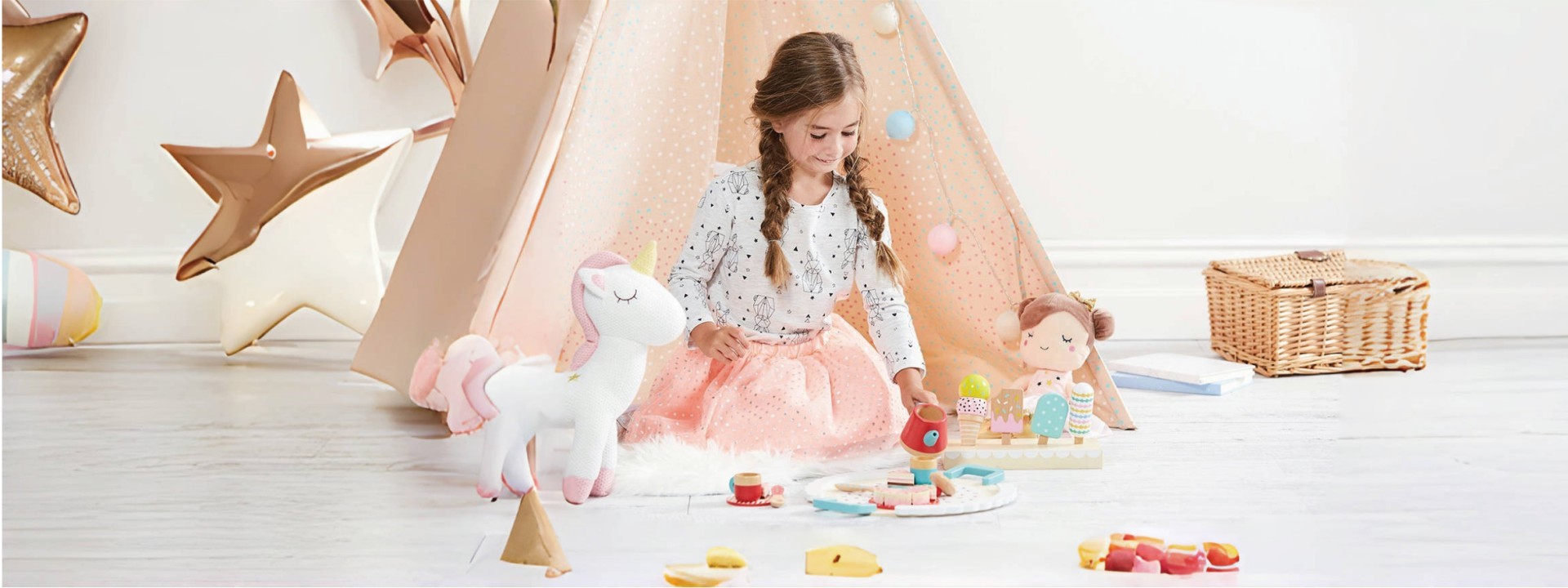
Pretend play allows children to step into different roles and scenarios, fostering creativity and problem-solving skills in a way that feels like pure fun. Watch a four-year-old at a wooden market stall and you will see a complete cognitive workout: pricing goods, counting coins, greeting customers, negotiating a "discount," and deciding what happens when the shop runs out of apples. Every one of those micro-decisions builds executive function — the set of mental skills that let children plan, focus, remember instructions, and juggle multiple tasks at once.
Role play also gives children a safe rehearsal space for real life. A child who is nervous about starting school can play "teacher" at home; a child processing a visit to the doctor can run a clinic with wooden instruments; a child learning to share can practise turn-taking with a wooden store and market set long before the stakes are real. Psychologists call this play-based rehearsal, and it is one of the most effective tools children have for managing new experiences and big feelings.
Because the scenario belongs entirely to the child, the adventures never repeat in quite the same way. One afternoon the wooden play scene is a farm; the next it is a space station. That flexibility is exactly what keeps children returning to the same toys week after week.
3. Open-Ended Play: One Simple Toy, Endless Possibilities
With wooden toys, the open-ended nature of their design inspires endless possibilities. Where a licensed character toy has one story attached to it, a plain wooden figurine has infinite ones. That is why educators prize open-ended wooden toys so highly: they adapt as the child grows, shifting from simple sensory exploration at age two to elaborate narrative play at age six, without ever becoming "babyish."
A wooden cash register, for instance, can transform a child into a shopkeeper, honing math and communication skills. The same register later becomes a bank, a ticket office, or a spaceship control panel. This adaptability delivers exceptional play value for families — one purchase supports years of development — and it explains why open-ended design is central to our wooden food and fruit toys and every other pretend set we build.
Educators working in Montessori and Waldorf settings rely on the same principle. If you would like to understand the pedagogy behind it, our article on how open-ended wooden toys enhance Montessori and Waldorf learning walks through the benefits and gives concrete examples. Families can also browse our complete range of wooden educational toys to see how the approach is applied across product categories.
4. Little Shopkeepers and Big Skills: Math, Language, and Communication
Nothing demonstrates the academic value of pretend play better than a market stall. Counting coins, making change, sorting produce by type, and estimating how many items fit in a basket are all early mathematical thinking, practised voluntarily because the shopkeeper's job requires it. Meanwhile, greeting customers, describing products, and negotiating prices build vocabulary and conversational confidence.
Our custom wooden store and market toys are designed for exactly these scenarios, with compartments, signage, and pieces sized for small hands so that the play flows without frustration. Pair them with a wooden food set and you have a complete pretend economy that supports hours of negotiation, sorting, and imaginative trade.
Language develops particularly quickly in these moments. A child running a shop narrates constantly — "Here is your bread, that will be three coins, would you like a bag?" — and that spontaneous narration is precisely how vocabulary and sentence structure expand. For more on the developmental arc, including the preschool years when this growth accelerates, see our guide to intellectual development in 3–5 year olds.
5. Dollhouses and Story Worlds: Building Language and Social Confidence
A dollhouse becomes the setting for storytelling, encouraging children to craft narratives that build their language and social abilities. Because a dollhouse represents a whole world — rooms, families, routines, conflicts, and resolutions — it invites the kind of sustained, multi-day storytelling that shorter play experiences rarely produce. Children invent characters, assign them personalities, and work through dilemmas: a lost key, a bedtime argument, a surprise birthday party.
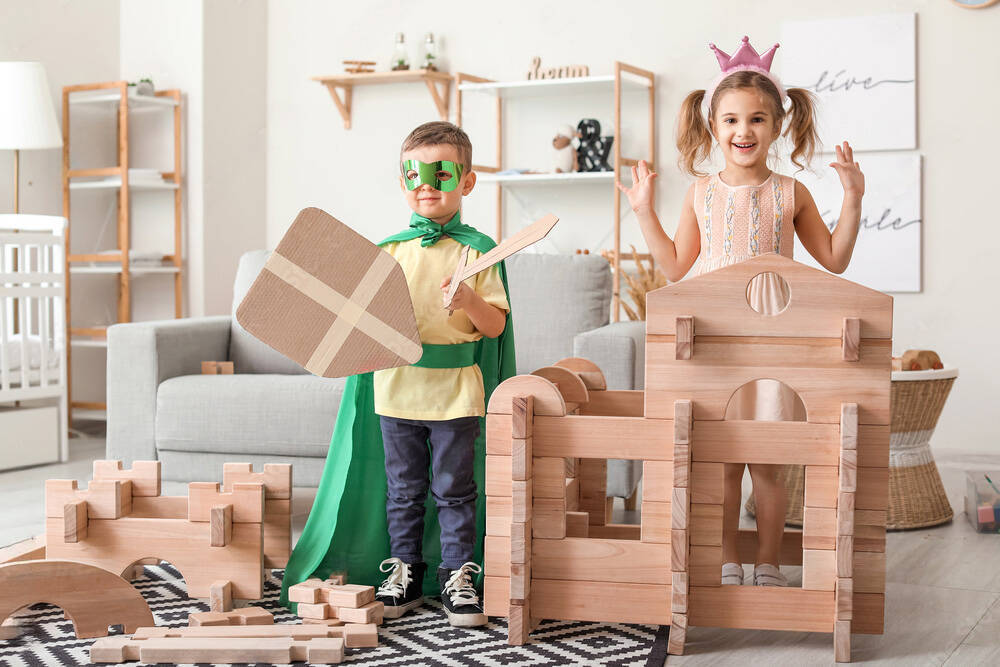
That narrative work has measurable benefits. Storytelling strengthens sequencing and memory, expands vocabulary, and gives children a safe way to explore emotions and relationships. It is also a natural bridge to social play: two children sharing a dollhouse must agree on who lives there, what happens next, and how the story ends — a genuine negotiation of shared imagination.
For richer play, dollhouses pair beautifully with 18-inch doll furniture, a wooden doll family, and a wooden toy theatre where the stories can be performed for an audience. Puppet play adds a further dimension of expression: our custom wooden puppets let shy children speak through a character, a technique child therapists have used for decades.
6. The Tactile Advantage: Sensory Play, Focus, and Fine Motor Skills
What makes wooden pretend toys especially unique is their tactile quality. Wooden toys rely on the child's input to bring them to life. Their sturdy, natural feel invites hands-on exploration, stimulating sensory engagement. Every turn of a wooden knob, click of a latch, or placement of a miniature plate is a small exercise in precision — the same fine motor practice that later supports handwriting, buttoning, and using tools.
Sensory engagement also supports attention. Because wooden toys are quiet and free of flashing lights or sudden sounds, they do not fragment a child's concentration: the play space stays calm, and children stay absorbed longer. Parents frequently notice that their child will spend forty minutes with a wooden kitchen but only a few with a battery-operated equivalent. That sustained focus is one of the most valuable outcomes of pretend play, and it grows stronger with practice.
Wood also offers natural variation that plastic cannot: different grains, tones, and weights. For a detailed comparison of materials and their sensory and developmental implications, read what makes wooden toys different from plastic toys. Keeping those toys clean and safe for years of play is simple too — our step-by-step guide on how to clean wooden toys covers everything parents need.
7. Built to Last: Sustainability, Durability, and Heirloom Value
Beyond their developmental benefits, wooden pretend toys contribute to a sustainable play environment. Made from eco-friendly materials, they are durable and long-lasting, often passed down through generations. A well-made wooden play kitchen or dollhouse is not a disposable purchase; it is an heirloom in the making, repaired rather than replaced, and valued rather than abandoned.
Sustainability runs deeper than the material itself. Sourcing matters: responsible manufacturers work with FSC-certified timber, water-based paints, and child-safe finishes that meet EN71 and ASTM F963 standards. We explain how our own supply chain approaches this in are wooden toys sustainable? and in our overview of how Forestoy ensures truly sustainable production.
Looking for a Pretend Play Range Your Customers Will Keep for Years?
From play kitchens and market stalls to dollhouses, puppets, and theatres, we design and manufacture wooden pretend play toys that combine heirloom durability with modern safety compliance.
8. Minimalist Design, Richer Play: How Simplicity Encourages Mindfulness
Wooden pretend toys have a minimalistic design that encourages mindfulness, promoting simpler — yet richer — play experiences. With no batteries, no screens, and no predetermined outcomes, play slows down. Children handle each piece deliberately, revisit the same scenario with new details, and stay in the moment instead of chasing the next stimulus. In a childhood increasingly shaped by fast, passive entertainment, that quiet engagement is a genuine gift.
Simplicity also reduces decision fatigue. A child faced with a single well-designed play set does not need instructions, an update, or a manual — they simply begin. This is one reason minimal, natural play materials are standard in Montessori-inspired homes and classrooms: our articles on why Montessori toys are important and on why wooden toys are the ideal choice for Montessori education explain the underlying philosophy in more detail.
Minimalism is also an aesthetic advantage for retailers. Neutral, natural finishes fit any nursery or playroom, photograph beautifully, and hold their appeal far longer than trend-driven designs — a practical consideration we explore in our guide to why wooden crafts make meaningful presents.
9. Choosing the Right Pretend Play Toys by Age and Stage
Children's pretend play evolves quickly, and the best wooden toys grow with the child. Here is how we think about the stages at FORESTOY:
Explore & Imitate
Toddlers copy what they see. Simple wooden tool kits, pots and spoons, and chunky play food support imitation play and build grasping strength and hand-eye coordination.
See tool & activity toys →Cook & Nurture
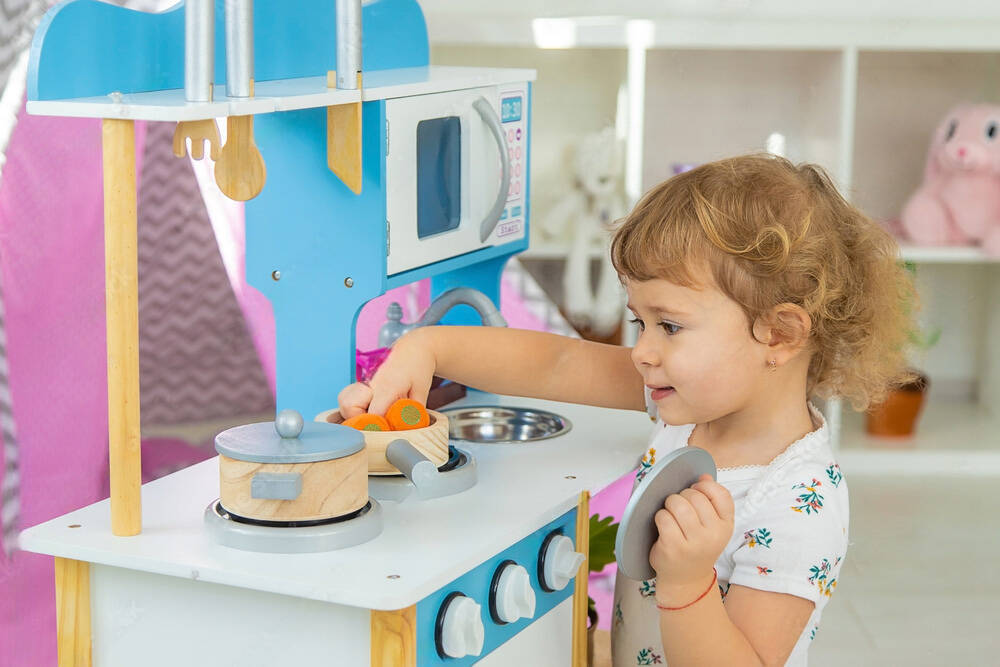
Play kitchens, tea sets, and doll care routines dominate the preschool years. This is when narrative play begins and vocabulary expands fastest.
See kitchen & accessories →Trade & Negotiate
Market stalls, cash registers, and doctor or vet sets introduce rules, roles, and turn-taking — early entrepreneurship with real math underneath.
See store & market toys →Build Story Worlds
Dollhouses, miniature furniture, and figure sets support the longest, most complex storytelling — and the deepest social negotiation.
See dollhouses & furniture →Perform & Express
Puppets and theatre sets give children a stage for emotions, humor, and storytelling — ideal for building confidence in quieter children.
See puppet & theatre toys →Invent Any World
Play scenes, building sets, and loose parts adapt to any story a child invents — the ultimate long-life investment in imaginative play.
See play scenes →10. What Makes a Truly Great Wooden Pretend Toy
Not every wooden toy is created equal. Whether you are a parent building a play shelf or a buyer selecting a range for your brand, these are the quality markers worth insisting on:
| Quality Marker | Why It Matters | What to Look For |
|---|---|---|
| Safe materials | Children mouth and handle toys constantly | FSC-certified wood, non-toxic water-based paint, no sharp edges |
| Certified compliance | Required for retail in most markets | EN71, ASTM F963, CPSIA documentation |
| Durable joinery | Pretend play is high-contact play | Glued and pinned joints, no loose small parts |
| Age-appropriate scale | Frustration kills imaginative momentum | Pieces sized for small hands, stable bases |
| Open-ended design | Determines years of play value | Neutral finishes, no licensed characters, modular pieces |
| Repairable construction | Extends product life and brand reputation | Replaceable parts and easy surface refinishing |
Safety and durability are not optional extras; they are the foundation of every product we ship. You can read how we verify them in how Forestoy ensures global safety and quality, and how we shorten development timelines while keeping those standards in our article on producing prototypes and shortening the wooden toy development cycle. Buyers comparing manufacturing models will also find our guides on OEM versus ODM wooden toys and on developing custom wooden toys in China useful starting points.
11. Let's Build the Next Adventure Together
Through role-playing adventures with wooden pretend toys, children unlock the power of their imaginations, stepping into worlds where they can explore, create, and grow. These timeless toys prove that the simplest tools often provide the most profound opportunities for development and joy.
For over two decades, FORESTOY has been dedicated to creating high-quality wooden toys that inspire imagination and learning. Our expert R&D team designs unique, durable toys crafted from sustainably sourced wood, combining eco-friendly materials with rigorous child safety. With advanced facilities, we ensure efficient production, strict quality checks, and timely delivery for brands, retailers, and educational programs around the world.
If you are developing a pretend play line — play kitchens, market stalls, dollhouses and miniature furniture, puppets, or theatres — our specialists will guide you from first concept sketch to final shipment.
Committed to enhancing children's play experiences, FORESTOY is your trusted partner for exceptional wooden toys. Reach out to us today — and let's turn imagination into a product your customers will love.