Private Label Wooden Toys: How Retail Brands Can Build a Custom Product Line
- Share
- publisher
- Forestoy
- Issue Time
- Oct 23,2026
Summary
A B2B playbook for private label wooden toys: how retail brands scope a 6-10 SKU range, run a six-gate development process, brand and barcode compliant packaging, plan MOQ across SKUs and container fill, and meet EN 71, ASTM F963 and CPSIA requirements with a 20-year China factory.
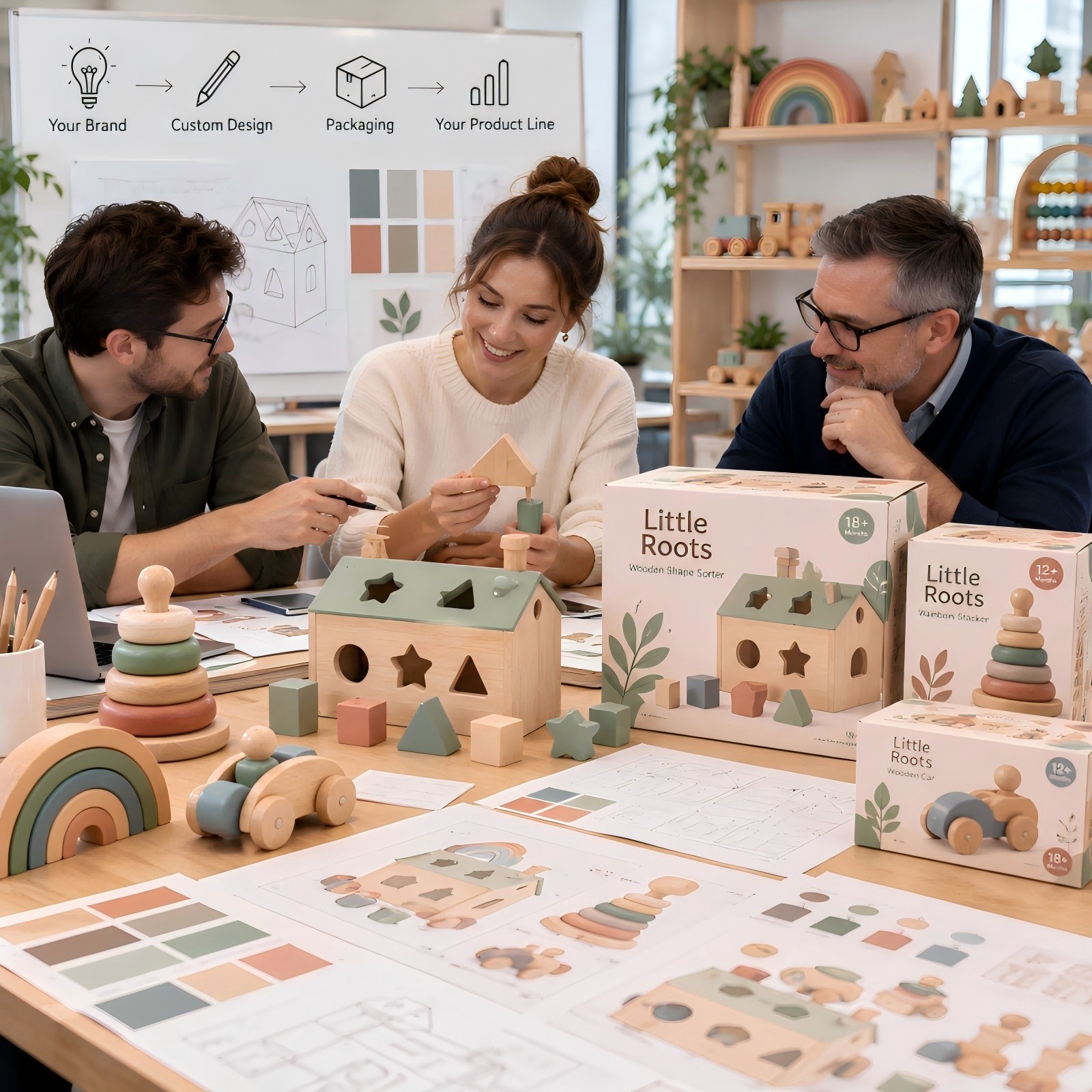
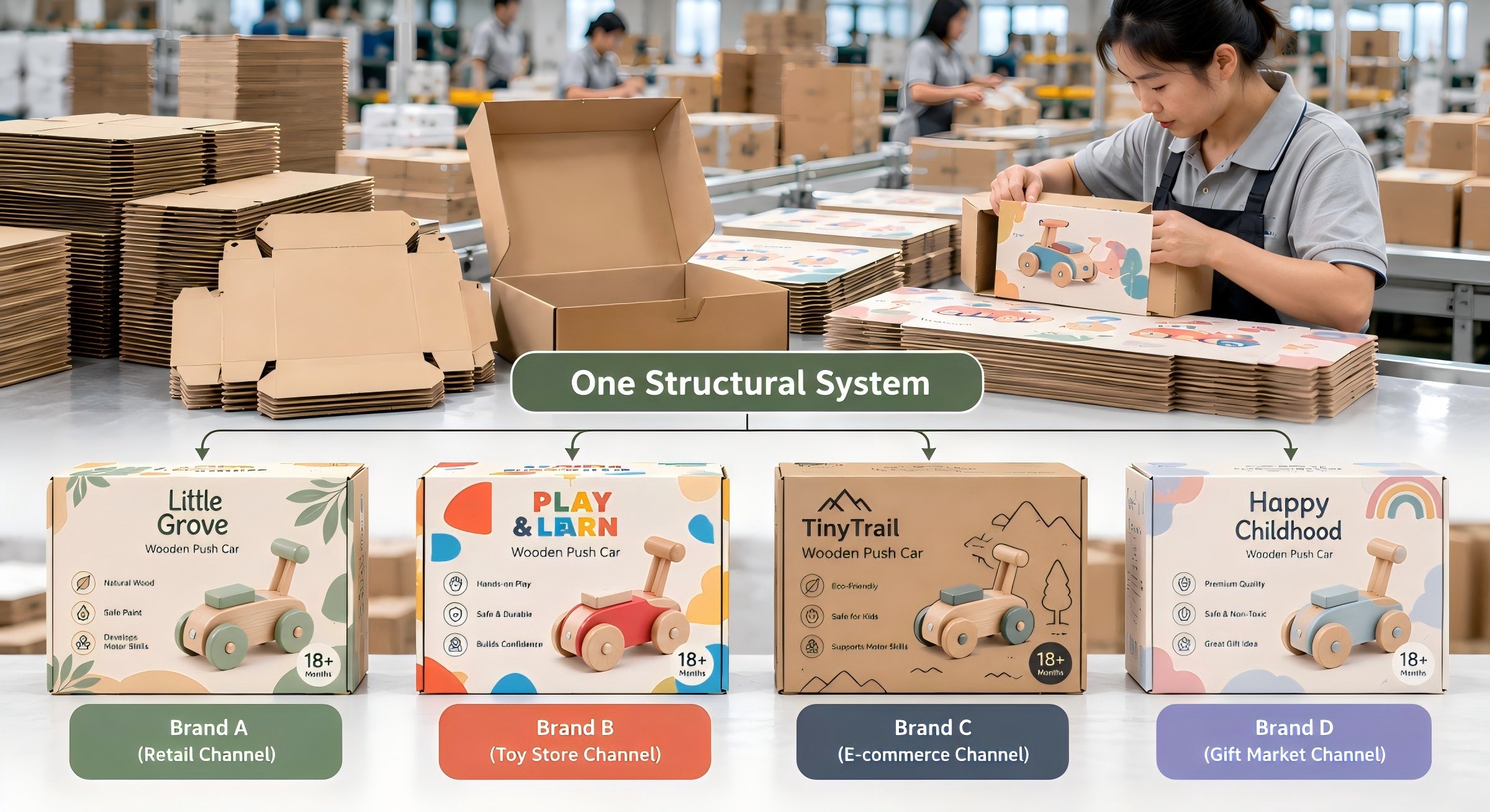
A private label wooden toys line looks deceptively simple on paper: pick a few products, put your logo on the box, place an order. In practice, roughly four out of five first-time private-label programmes we quote run into the same four walls — a range that cannibalises itself, a packaging spec that breaks the MOQ maths, artwork that fails compliance review, and a multi-SKU order that no single container can carry efficiently. This guide is written for retail brands, e-commerce sellers, distributors and startup founders building a wooden toy collection under their own name. It covers how private label actually differs from white label, how to scope a range that sells, the development sequence that keeps a launch on schedule, branding and barcode requirements, and how MOQ really behaves across a multi-SKU order. Private label means the retailer or brand owns the product identity: the brand name on the box is yours, the artwork is yours, the GTIN is yours, and — critically — the specification is yours. The factory manufactures to your brief and does not sell that exact branded item to anyone else. White label, by contrast, is a catalogue product the factory already sells under its own reference, which you may be allowed to re-brand with minimal changes; the design and often the packaging structure remain shared. Licensing is a third model entirely, where you rent someone else's brand equity. The distinction matters commercially because it defines what you can defend. A white-label arrangement gets you to market in weeks, but your competitor can buy the same product from the same factory next month. A private-label programme costs more in development and tooling, but it gives you exclusivity on specification, packaging and often on the mould itself — which is the only durable margin protection in a category where the raw materials are identical across every supplier. Most successful private label wooden toys manufacturers relationships sit in the middle: a proven factory platform, re-engineered to your dimensions, colourway, accessories and packaging. The structural argument is margin and differentiation. Global toy sales have held above USD 100 billion a year in recent industry reviews from Statista and Circana, but the category is crowded with identical SKUs competing on price. Store brands have been gaining share across discretionary retail for a decade — PLMA and NielsenIQ retail reporting consistently shows store-brand penetration rising fastest in categories where the underlying product is undifferentiated — and wooden toys fit that profile precisely: parents buy on material, safety and developmental value, not on a character licence. Four concrete advantages follow. Margin control: buying factory-direct removes the importer markup that sits between a branded supplier and your shelf. Catalogue coherence: one design language across 8–20 SKUs reads as a brand, while a mixed bag of white-label items reads as a discounter. Channel flexibility: the same product can ship in retail packaging for stores and mail-order packaging for e-commerce, using our custom wooden toy solutions structure. Data ownership: your GTINs, your barcodes, your marketplace listings, your reviews — assets that stay with you if you change factories. Range selection is where most first programmes fail. The instinct is to cover every age and every theme; the result is 30 SKUs that each sell 200 units and never amortise tooling. A better starting rule: launch 6–10 SKUs across two adjacent age bands, with one hero product that carries marketing and five to nine supporting items that lift average basket value. The five families below cover the demand reliably. The highest-value entry point, because parents pay for developmental claims and the products have long lifecycles. Shape sorters, stacking sets, counting boards and wooden educational toys anchor a range and rarely go out of season. The specification discipline is strict here: single-concept design, no batteries, and precise tolerances, as we set out in our Montessori wooden toy manufacturer guide. Kitchens, markets, tool benches and doll houses deliver the highest unit prices and the strongest gifting demand. They are also the most packaging-hungry: large cartons, more assembly, and shelf presence that depends on the box. Our wooden pretend play toys platform covers this family with adjustable accessories and modular configurations. The lowest-risk volume drivers. Puzzles and board games compress into small cartons, tolerate lower MOQs, and sell steadily at low price points. They are the right choice for testing a new market before committing to furniture-scale tooling — see our wooden board game and puzzle block platforms. Rainbow stackers, building planks and loose parts. Cheap to tool, expensive to compete on, because the design language carries the value. This family is where private label genuinely beats white label: a distinctive palette and form set is defensible in a way a generic stacker never is. Cars, trains, balance bikes and construction sets attract gift buyers and fathers-as-shoppers, and they photograph well for e-commerce. Engineering content is higher — axles, wheels, moving joints — which makes prototype testing non-negotiable. Our custom wooden vehicles range shows how far a platform can be stretched before new tooling is required. A private-label line is a development project with a critical path, not a purchase order. Ours runs through six gates, and each one exists to stop a specific, expensive failure. The full sequence, including how artwork, engineering and sampling interlock, is documented on our wooden toy design and development process page. Sampling typically takes 7–10 days after design confirmation; the gate that most often slips is packaging artwork approval, which is why we run it in parallel from gate two rather than after the toy is signed off. This is where private label becomes real, and where the compliance surface is widest. Every pack needs an age grading that matches the tested age range, the correct choking-hazard wording for each market, a CPSIA tracking label for US-bound children's products, and — since 13 December 2024 — an EU responsible person identified on the pack or listing under GPSR (EU) 2023/988. The barcode must be a GS1-licensed GTIN printed within the standard's magnification range, because retailer chargebacks for unscannable barcodes are routine and entirely avoidable. Beyond compliance, three branding decisions do most of the selling. The front panel needs one readable promise, not five. The material story — FSC-certified fibre, water-based finishes — should be verifiable, not decorative. And the channel variant matters: retail cartons optimise for shelf presence while mail-order packs optimise for surviving parcel networks unopened. Our private-label wooden toy packaging guide covers structures, board grades and MOQ implications in detail. MOQ in wooden toys is not one number; it is the sum of several setup costs, and understanding which ones you are paying for is the difference between a viable launch and a stalled one. There are three cost layers. Per-order: material buying, machine setup and packing-line changeover — this is why a single-SKU order of 300 pieces costs almost the same per unit as 600. Per-SKU: tooling, jigs, fixtures and any custom component. Per-design: print plates and die-cut dies, which is why full custom colour boxes typically start near 1,000 pieces while a stock box with a printed belly band can start around 500. Two planning disciplines keep a multi-SKU order efficient. First, share components across the range: one wheel, one knob, one hinge and one carton size used by four SKUs cuts tooling and simplifies inspection. Second, plan the container, not just the order. A 40-foot high-cube holds around 68 cubic metres of usable volume, so a 12-SKU launch with 0.05 m³ cartons needs roughly 1,100 cartons to fill it — meaning 4,000–5,000 units in total. Orders well below that threshold are perfectly manufacturable, but they ship LCL and the freight-per-unit penalty is real; it belongs in your landed-cost model from day one. Buyer tip: ask for a costed MOQ ladder at three volumes per SKU — for example 500, 1,000 and 3,000 pieces — before you finalise the range. Seeing where the unit price flattens tells you exactly which SKUs to launch deep and which to launch thin. Private label transfers product liability to you, which makes the compliance file the most valuable document in the project. Three regimes cover most launches. In the EU, EN 71-1 governs mechanical and physical safety, EN 71-2 flammability and EN 71-3 migration of 19 heavy elements, all under Toy Safety Directive 2009/48/EC with CE marking and a technical file retained for ten years. In the US, ASTM F963 is mandatory via 16 CFR 1250, with CPSIA limiting lead to 100 ppm in substrate and 90 ppm in paint, and certain phthalates to 0.1%. For the under-threes who dominate the educational segment, components must survive torque testing at 0.45 N·m and tension at 67 N, and pass the 31.7 mm small-parts cylinder test. Material control is the other half. Beech and rubberwood should be kiln-dried to roughly 8–12% moisture content, and finishes should be water-based and saliva-resistant. Our wooden toy safety and quality control system pairs in-house physical and chemical screening with third-party certification through bodies such as SGS, TÜV, BV and Intertek, and we run three free inspections per order. For the manufacturing equipment and capacity behind those claims, see our wooden toy manufacturing capacity page; for the wider factory picture, our factory capabilities overview covers facilities, teams and export experience. Forestoy has manufactured wooden toys and children's furniture for more than 20 years and supplies over 100 brands across Europe, North America and Asia. For private label wooden toys programmes specifically, that experience translates into four working advantages. In-house design and engineering review your range for manufacturability, age grading and compliance before tooling, not after. Flexible MOQs let a brand launch tight and scale the winners. Packaging engineering — dielines, retail artwork, mail-order packs — sits on the same production floor as the toys, so packaging never becomes the critical path. And sustainability is engineered rather than claimed: FSC-certified fibre, water-based finishes, moulded-pulp inserts and solar-powered production, documented on our sustainable wooden toy materials page. If you want to see how a single platform can be re-engineered into a full retail line, our custom learning tower and open-ended wooden toys platforms are the clearest examples: one structural concept, five to nine retail variants, one packaging system. The complete range is in our wooden toy product catalogue, and the downloadable line sheet is on our catalogue download page. Send one brief and we will return a worked range proposal — platform options, age grading, packaging direction and a costed MOQ ladder. Three ways to begin:
What Are Private Label Wooden Toys?
Why Private Label Works for Toy Retailers
Choosing the Right Product Range
Montessori and Educational Toys
Pretend Play
Puzzles and Games
Open-Ended Toys
Wooden Vehicles and STEM Toys
Private Label Development Process
Branding, Packaging and Barcode Support
MOQ and Multi-SKU Planning
Quality and Safety Requirements
How Forestoy Supports Private-Label Wooden Toy Brands
Start Your Private-Label Product Line
Standards and Sources Referenced