Montessori Wooden Toy Manufacturer in China: What B2B Buyers Should Know
- Share
- publisher
- Forestoy
- Issue Time
- Oct 20,2026
Summary
A B2B sourcing guide to Montessori wooden toys made in China: what genuinely makes a toy Montessori-inspired, wood and finish standards, EN 71, ASTM F963, CPSIA and GPSR compliance, OEM/ODM development stages, QC checkpoints and retail assortment planning.
Demand for Montessori wooden toys has moved from a niche education movement into mainstream retail, and buyers who treat it as an ordinary wooden toy category get burned by the difference. A credible Montessori wooden toy manufacturer has to understand pedagogy, materials science and three regulatory systems at once, because your customers — Montessori schools, parenting influencers and safety-conscious parents — will notice every shortcut.
This guide is written for brand owners, educational retailers, preschool groups and distributors evaluating Montessori wooden toys suppliers in China. It covers what actually makes a toy Montessori-inspired, which material and finish standards to demand, how EN 71, ASTM F963 and CPSIA apply, and how to structure an OEM or ODM project — the same process we run every week on our own production floor.
Why Montessori Wooden Toys Are Attractive to B2B Buyers
The global toy market has held above USD 100 billion in annual sales for several consecutive years according to industry trackers such as Statista and Circana, but growth is not evenly distributed. Value is shifting toward open-ended, screen-free and sustainably made products — exactly the positioning that Montessori-inspired wooden learning toys occupy. The Montessori method, developed by Dr Maria Montessori after she opened the first Casa dei Bambini in Rome in 1907, is today practised in tens of thousands of schools worldwide and referenced daily by millions of parents on social platforms. That gives the category something most toy segments lack: a permanent, self-renewing stream of consumer education.
For a B2B buyer, that translates into three commercial advantages. First, price resilience: parents buying for developmental value are less discount-driven than mass-market toy shoppers, so margins hold better. Second, longer product lifecycles: classic materials such as knobbed cylinders, the pink tower or a toddler learning tower do not expire with a film licence or a trend cycle, which lowers catalogue maintenance cost. Third, cross-channel demand: the same SKU sells to Montessori schools, preschool chains, specialty retail, subscription boxes and Amazon private label — one development investment, many channels.
China is the practical production base for almost all of this volume. The wooden toy clusters in Zhejiang and the Yunhe corridor concentrate beech and rubberwood machining, water-based paint supply, packaging print and third-party testing laboratories within a short radius, a supply-chain density no other region currently matches at scale.
What Makes a Wooden Toy Montessori-Inspired?
There is no legal definition of a "Montessori toy", which is precisely why the market is full of products that are merely wooden. A genuine Montessori wooden toy manufacturer designs against the method's core principles, and you should be able to see each of them in the sample in your hand.
Hands-On Learning
Montessori materials are manipulatives first. The child's hand must do real work — grasping, threading, pouring, stacking, latching — rather than pressing a button and watching a response. In practice this means weighted, well-balanced wooden parts with tolerances tight enough that a knobbed cylinder either fits its socket or does not. That binary feedback is the teaching mechanism, and it is only achievable with precise machining and consistent sanding, not with rough die-cut parts.
Simple and Purposeful Design
Classic materials follow the principle of isolation of quality: each material teaches one concept and one variable at a time — height only in the brown stair, diameter only in the knobbed cylinders. Batteries, flashing lights, cartoon faces and random multi-function features are not merely unnecessary; they actively break the pedagogy. When you review a supplier catalogue, count the concepts per product. One clear concept, executed precisely, is the Montessori signature.
Fine-Motor Development
Good preschool wooden toys are calibrated to the hand that will use them. Knobs must match a toddler's pincer grip, latch boards must require controlled wrist rotation, and pouring sets must be sized so a three-year-old can succeed after practice but not on the first attempt — that productive difficulty is what builds fine-motor control. A manufacturer that cannot explain why a knob is 22 mm and not 30 mm is decorating, not designing.
Open-Ended Learning
Beyond the classic didactic materials, modern Montessori-inspired retail also embraces open-ended play: rainbow stackers, building boards, busy boards and pretend-play kitchen sets that support practical life skills. These have no single correct outcome, which extends play value across age groups and extends the sell-through window on your shelf.
What to Look for in a Montessori Wooden Toy Manufacturer
Because "Montessori" is not a licensed term in most markets, due diligence shifts entirely onto the manufacturer. Before shortlisting any Montessori wooden toy supplier, verify the following, and ask for evidence rather than adjectives.
| Evaluation Point | What a Qualified Manufacturer Can Show You |
|---|---|
| Pedagogical design capability | An in-house design and engineering team that can discuss age grading, control of error and isolation of quality during drawing review, not just render your sketch |
| Material traceability | FSC Chain-of-Custody documentation for hardwood inputs, with wood species such as beech, rubberwood or birch plywood declared per SKU |
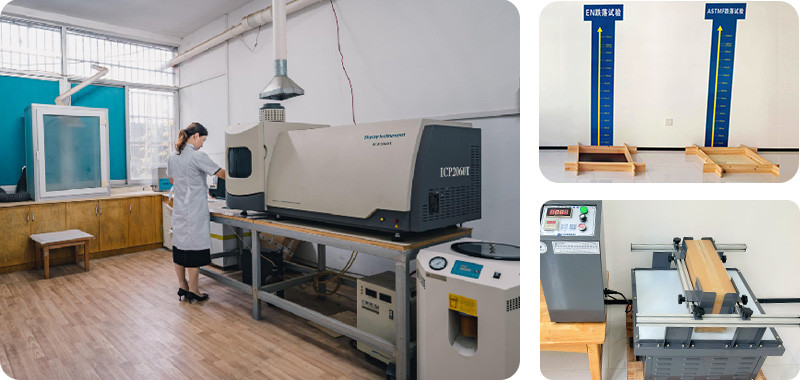
| In-house physical testing | Torque, tension, drop, impact and small-parts cylinder testing on site, with records retained per production batch |
| Chemical compliance | Third-party EN 71-3 and CPSIA reports from accredited laboratories such as SGS, TÜV, BV or Intertek, plus incoming paint and glue control |
| Quality system | ISO 9001-based QC workflow, defined AQL sampling, and acceptance of your own third-party inspection |
| OEM and ODM workflow | A documented path from brief to prototype, white mockup, safety testing and golden sample, with sample lead times in writing |
| Social compliance | amfori BSCI or equivalent factory audit, increasingly a condition of entry for EU and US retail chains |
You can see how each of these points is documented in our wooden toy safety and quality control system, which spans new-design safety assessment, in-process inspection and pre-shipment AQL checks.
Materials, Finishes and Product Safety
Montessori positioning makes material claims a commercial feature rather than fine print. These are the standards we treat as non-negotiable on every Montessori programme.
- Wood selection and moisture control. Solid beech and rubberwood should be kiln-dried to roughly 8–12% moisture content before machining; skip this and you receive cracked components one shipping season later. Birch plywood is the standard for large flat panels, and every piece should be sanded through progressive grits to a splinter-free edge, because Montessori toys are handled with bare hands, for hours, on the floor.
- Finishes. Unfinished or clear water-based lacquer is traditional for sensorial materials; where colour is used, insist on water-based, saliva-resistant paint. In the EU, EN 71-3 governs migration of 19 heavy elements from toy materials. In the US, CPSIA caps lead at 100 ppm in substrate and 90 ppm in paint or coating, with certain phthalates limited to 0.1%. Ask which specific limit values your supplier tests to — "non-toxic" is not a specification.
- Mechanical safety. Under ASTM F963, mandatory in the US via 16 CFR 1250, and EN 71-1 in the EU, components are torque-tested at 0.45 N·m and tension-tested at 67 N to prove small parts cannot detach — the classic choke hazard for the under-threes who form the core Montessori age group. Toys for children under 36 months must also pass the small-parts cylinder test at 31.7 mm by 25.4–57.1 mm.
- Documentation. Since 13 December 2024, the EU General Product Safety Regulation (EU) 2023/988 requires a responsible economic operator established in the EU to be identified on the product or listing. Plan this into packaging artwork and marketplace files at the design stage; it is the most common compliance gap we see with new importers.
- Sustainability claims. If you market FSC-certified wood, the claim must be backed by Chain-of-Custody certification under FSC-STD-40-004 all the way to your supplier. Retail buyers increasingly cross-check this.
Our sustainable wooden toy materials programme covers certified sourcing, solar-powered production and two-stage wastewater treatment from painting operations — details worth keeping in your supplier audit file.
OEM and ODM for Montessori Wooden Toys
Most B2B buyers arrive with one of two briefs. In an OEM project you bring drawings or a reference product and the factory engineers it for production. In an ODM project you select from the manufacturer's existing catalogue and customise branding, colourway and packaging. Montessori buyers usually blend the two, adapting a proven learning tower platform with their own dimensions, accessories and retail packaging.
Whichever route you take, the controlling document should be a stage-gated development process. Ours runs from market research and idea screening through detailed design, prototype making and physical testing, to final sample approval and mass-production preparation; the full sequence is set out in our wooden toy design and development process. Practically, three checkpoints decide whether a project succeeds.
- White mockup review. An unpainted prototype lets you verify proportions, grip sizes and stability before money is sunk into tooling and artwork. Judge a factory by whether it offers this stage unprompted.
- Physical testing of the prototype. Torque, tension, drop and stability tests on the mockup, not on the finished painted sample, catch structural problems while they are still cheap to fix.
- Golden sample sign-off. The approved sample, together with packaging proof and instruction manual, becomes the contractual reference for bulk AQL inspection. At Forestoy, samples ship 7–10 days after design confirmation, depending on complexity.
If you are still deciding between cooperation models, our OEM versus ODM comparison guide breaks down the cost, IP and lead-time trade-offs.
Popular Montessori Wooden Toy Categories for Retailers
Assortment planning for the Montessori shelf clusters around five proven families, all of which we produce as standard platforms ready for customisation.
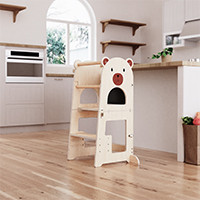
- Learning towers and kitchen helpers. The fastest-growing Montessori-adjacent category: a wooden Montessori learning tower that safely raises a toddler to counter height, with adjustable platforms, foldable frames and anti-tip geometry. Structural stability and fall prevention dominate the safety brief.
- Sensorial and manipulative sets. Stacking, sorting, threading and shape-fitting materials that teach one variable at a time, at the heart of any wooden educational toys range.
- Practical life and pretend play. Kitchen sets, tool benches, cleaning and care stations that mirror adult activity; these support the practical life curriculum and pair naturally with learning towers.
- Busy boards and fine-motor panels. Latches, buckles, gears and locks, where every component must be individually tested for detachment, so supplier testing depth matters more here than anywhere else.
- Baby and toddler grasp toys. Interlocking discs, rattles and first puzzles for ages 0–3, where EN 71-1 and small-parts compliance is effectively the whole product story.
For adjacent categories that round out a Montessori-leaning catalogue, including outdoor play, games, music and kids' furniture, browse the complete wooden toy product catalogue.
How Forestoy Develops Montessori-Inspired Wooden Toys
Forestoy has manufactured wooden toys and children's furniture for more than 20 years and supplies over 100 brands across Europe, North America and Asia. That history shows up in the details a first sample run exposes. Our production line covers twelve controlled stages, from material preparation, cutting and multi-stage sanding through engraving, water-based painting and assembly to in-line and pre-shipment inspection, and our wooden toy manufacturing capacity page documents the equipment behind each stage.
Three commitments matter most to Montessori buyers. First, dual testing: every product passes in-house physical and chemical screening using digital torque and tension testers, drop testers, small-parts cylinders, X-ray fluorescence and gas chromatography, and all toys are certified by internationally recognised bodies such as SGS, TÜV, BV and Intertek. Second, three free inspections: we inspect after bulk sample production, mid-production and pre-shipment at an AQL of major 2.5 and minor 4.0, at our cost, and we welcome your own third-party inspector on site. Third, design partnership: our structural and graphic designers work from child-development briefs, which is why we can review a Montessori concept for pedagogical soundness as well as manufacturability, and why our own kitchen-helper platform evolved through four development iterations into a foldable, height-adjustable tower now sold under multiple partner brands.
Everything above is delivered under custom wooden toy solutions structured around flexible MOQs, because a Montessori range typically starts with a tight SKU set and one colour box rather than a container of assorted stock.
Five Questions to Ask Before You Place a Montessori Order
Bring this list to your next supplier conversation. A factory that answers all five with documents rather than assurances is one you can build a catalogue on.
- Which exact limit values and standard versions do you test to, including EN 71 editions, ASTM F963 and CPSIA lead and phthalate limits, and can I see the latest third-party report for a comparable product?
- What is your wood species, origin and moisture-content control, and does your FSC Chain-of-Custody cover this SKU?
- What is your sample lead time, and does the process include an unpainted white mockup stage?
- What are your AQL levels and inspection stages, and will you accept our appointed third-party inspector?
- Who acts as our EU responsible person under GPSR, and how is that compliance information printed on packaging and marketplace listings?
Buyer tip: ask for the unpainted prototype and the painted golden sample as two separate approvals. Collapsing them into a single sign-off is the most common, and most expensive, mistake importers make on Montessori programmes.

Source Montessori Wooden Toys from a Manufacturer You Can Audit
The fastest way to evaluate Forestoy is not another page of reading. It is putting our documents and our sample on your desk. Choose the starting point that matches your stage.
- Get the factory audit pack — certifications, QC workflow, AQL standards and test reports, ready for your compliance file.
- Request a free Montessori sample evaluation — send a drawing, reference product or simply your target age group and price point, and our design team will return a development route and quotation.
- Book a video factory tour — walk our sanding, painting and testing lines with your sourcing team before you travel.
Standards and Sources Referenced
- ASTM F963, Standard Consumer Safety Specification for Toy Safety, mandatory in the US under 16 CFR 1250 and the Consumer Product Safety Improvement Act of 2008.
- EN 71-1 (mechanical and physical properties), EN 71-2 (flammability) and EN 71-3 (migration of certain elements) under EU Toy Safety Directive 2009/48/EC.
- EU General Product Safety Regulation (EU) 2023/988, applicable since 13 December 2024.
- CPSIA lead limits (100 ppm substrate, 90 ppm paint) and phthalate limits (0.1%).
- FSC Chain-of-Custody Standard FSC-STD-40-004, ISO 9001 quality management, amfori BSCI social compliance.
- Global toy market size estimates from Statista and Circana annual industry reviews.