Educational Wooden Toys Manufacturer: How to Build a High-Value Learning Toy Collection
- Share
- publisher
- Forestoy
- Issue Time
- Oct 26,2026
Summary
A B2B guide to building an educational wooden toy collection: why the learning segment outperforms, six core product families, a five-layer supplier audit, age-band design rules, EN 71 / ASTM F963 / CPSIA compliance, and OEM/ODM development from a 20-year China factory.

Educational wooden toys are the most defensible segment of the toy shelf: parents pay for developmental value, retailers pay for repeat purchase, and the category rewards suppliers who can prove both safety and pedagogy. But building a collection that sells through — rather than filling a warehouse — starts with choosing the right educational wooden toys manufacturer and structuring the range around how children actually learn. This guide is written for educational brands, retailers, preschool chains and distributors planning a wooden learning range. It covers why the category keeps outperforming, the six product families that carry demand, how to audit a supplier, how to design across age bands, and where OEM/ODM development creates margin. Global toy sales have held above USD 100 billion a year in recent Statista and Circana industry reviews, but the composition is shifting. The fastest-defending share is the learning and STEM segment, where parents treat price as secondary to developmental outcome — Circana's category reporting repeatedly shows construction, brainteaser and educational lines outgrowing the overall market. Two structural currents favour the wooden sub-segment specifically. First, materials matter to the buyer, not just the child. EU and US parents increasingly screen for plastic-free alternatives, and wooden toys carry a durability story that supports gifting and hand-me-down economics — a purchase justification no battery-operated competitor can match. Second, institutional demand is stable. Preschools, Montessori settings and family-play centres buy on safety files and lifespan, not on licence trends, which makes preschool wooden toys manufacturer relationships unusually resilient across retail cycles. A range built on these two currents sells through year after year, which is precisely what a distributor or retail buyer is paid to find. A collection that merchandises well covers six families, each with a distinct developmental claim and price point. The strongest educational wooden toy manufacturer relationships assign every SKU to one of these families before any design work begins. The entry family, typically 12–36 months. A good sorter teaches spatial matching, grip refinement and cause-effect in one object, and it is the family where tooling cost per unit is lowest. Look for chamfered holes that forgive near-misses (toddlers perseverate on failures), a lid that opens for retrieval without pinching, and pieces large enough to clear the 31.7 mm small-parts cylinder. Our wooden shape sorter and stacker platform covers cube, drum and house formats on shared tooling. Number boards, counting puzzles and peg sets translate numeracy into hands-on play for ages 3–6. The design risk is decorative numbers: a counting toy only works if quantity is visually consistent — ten pegs must be ten identical heights — which is a tolerance question, not an artwork question. This is where an established wooden learning toys manufacturer earns the premium: consistent jig-accurate printing and pieces that survive classroom handling. Chunky puzzles, knob puzzles and layered story puzzles carry the highest sell-through per shelf metre in the family because they compress into small cartons and read clearly in retail. Piece thickness, knob diameter and image-to-board registration are the three failure points we control at first-article inspection on every wooden puzzle run. Lacing boards, threading beads, bolt boards and dressing frames develop the pincer grip that underwrites later writing skills. They are also the quiet stars of the preschool channel: compact, silent, and endlessly re-usable. The engineering question is cord security — EN 71-1 limits cord length and requires secure anchoring, which we test on the prototype, not on the shipment. Marble runs, gear sets, balance towers and simple-machine kits extend the range into ages 5+ with the strongest price positioning. As a wooden STEM toys manufacturer, we see this family drive the highest average order value in distributor catalogues — and demand the tightest tolerances, because a marble run that jams loses its magic on the first play. Our wooden STEM learning toys range is engineered around repeatable physics, not packaging claims. Xylophones, tambourines, market stalls and tool benches close the loop between learning and language. Musical toys carry an added acoustic specification — an out-of-tune glockenspiel is returned, not tolerated — while role-play sets benefit from the modular accessory systems described on our wooden music toys platform. Certificates on a website are the beginning of diligence, not the end of it. When we are audited by brand compliance teams, they work through five layers — and any buyer can apply the same sequence. Our wooden toy safety and quality control system documents each layer, and the equipment behind it — four production workshops, an in-house laboratory and a twelve-stage line — is itemised on our wooden toy manufacturing capacity page. Buyer tip: ask every candidate supplier for the last three non-conformance reports and how they were closed. A factory that can show its failures and the corrective actions is a factory with a working quality system. Age grading is a safety decision, a merchandising decision and a legal statement — in that order. The age label on the box must match the tested age range of the safety assessment, so it should be fixed during design, not chosen at artwork stage. Two adjacent age bands are the practical maximum for a first collection: they share safety parameters and merchandising logic while widening the addressable shelf. The Montessori-specific material standards behind the 12–36 month band are set out in detail in our Montessori wooden toy manufacturer guide. The compliance file for a learning range has three regimes. In the EU, EN 71-1 mechanical/physical, EN 71-2 flammability and EN 71-3 migration of 19 heavy elements operate under Toy Safety Directive 2009/48/EC with CE marking and a technical file retained ten years. In the US, ASTM F963 is mandatory via 16 CFR 1250, with CPSIA lead limits of 100 ppm in substrate and 90 ppm in paint and phthalates restricted to 0.1%. For the under-threes, components must survive torque testing at 0.45 N·m and tension at 67 N before the design is frozen. Durability lives in the material spec, not the marketing copy. Beech and rubberwood should be kiln-dried to 8–12% moisture content — the range that prevents cracking in a heated classroom or a humid container — and finishes should be water-based and saliva-resistant. FSC Chain-of-Custody certification (FSC-STD-40-004) underwrites the material claim on the pack, which matters more in educational channels than anywhere else: preschool procurement officers verify it. Sustainability engineering, from moulded-pulp inserts to solar-powered production, is documented on our sustainable wooden toy materials page. This is where a wooden educational toys China programme stops being buying and becomes product strategy. In OEM development, your brand owns the design: we engineer to your brief, your age grading, your colourway — and the specification becomes exclusive to you, which is the only durable margin protection in this category. In ODM development, you start from a proven platform — a sorter mechanism, a puzzle system, a marble-run chassis — and we re-engineer dimensions, themes and packaging around your brand, cutting both development risk and time-to-shelf. The commercial mechanics matter. Platform reuse collapses tooling cost: one wheel diameter, one board thickness and one peg system across six SKUs can cut per-SKU tooling spend by more than half compared with six bespoke designs. Development runs through our wooden toy design and development process — brief, platform selection, white mockup, prototype safety testing, golden sample, first article — with sampling typically 7–10 days after design confirmation. A worked comparison of the two models, including where each creates defensible value, is in our OEM vs ODM wooden toys guide; the mechanics of custom development are detailed in our OEM wooden toy development guide. Forestoy has manufactured wooden toys and children's furniture for more than 20 years and supplies over 100 brands across Europe, North America and Asia. For educational programmes specifically, four capabilities do the work. A dedicated wooden educational toys platform with shared tooling across sorters, counting sets, puzzles and lacing systems — the fastest route from brief to shelf. In-house design and engineering that reviews every concept against age grading and EN 71 / ASTM F963 parameters before tooling, not after. An in-house laboratory running torque, tension, drop and migration screening alongside accredited third-party certification. And a Montessori product line — learning towers, climbing furniture, shape-matching systems — documented on our Montessori educational toys page, which gives educational brands a ready-to-customise foundation for the 0–3 band. For buyers assembling a full sourcing programme alongside product, our wooden toy wholesale buying guide covers MOQ, pricing and quality across a whole catalogue, and the complete range is browsable in our wooden toy product catalogue. Send one brief — target ages, market, price positioning — and we will return a worked collection proposal with platform options, age grading and a costed MOQ ladder. Three ways to begin:
Why Educational Wooden Toys Remain Strong in B2B Retail
Core Educational Wooden Toy Categories
Shape Sorters
Counting and Math Toys
Puzzles
Fine-Motor Activities
STEM and Construction Toys
Music and Pretend Play

How to Evaluate an Educational Wooden Toy Manufacturer
Design for Different Age Groups
Age band Developmental focus Design discipline 0–12 months Grasping, mouthing, visual tracking No small parts, saliva-resistant finishes, rounded radii, no detachable components that fail the 31.7 mm cylinder 12–36 months Matching, stacking, first cause-effect Single-concept toys, forgiving tolerances, robust joints — this band is the hardest user group on the planet 3–6 years Numeracy, literacy, fine motor, cooperative play Progressive difficulty, classroom-grade durability, consistent piece systems across the range 6+ years STEM logic, construction, strategy Repeatable mechanics, higher piece counts, precise fit — tolerances tighten as ages rise 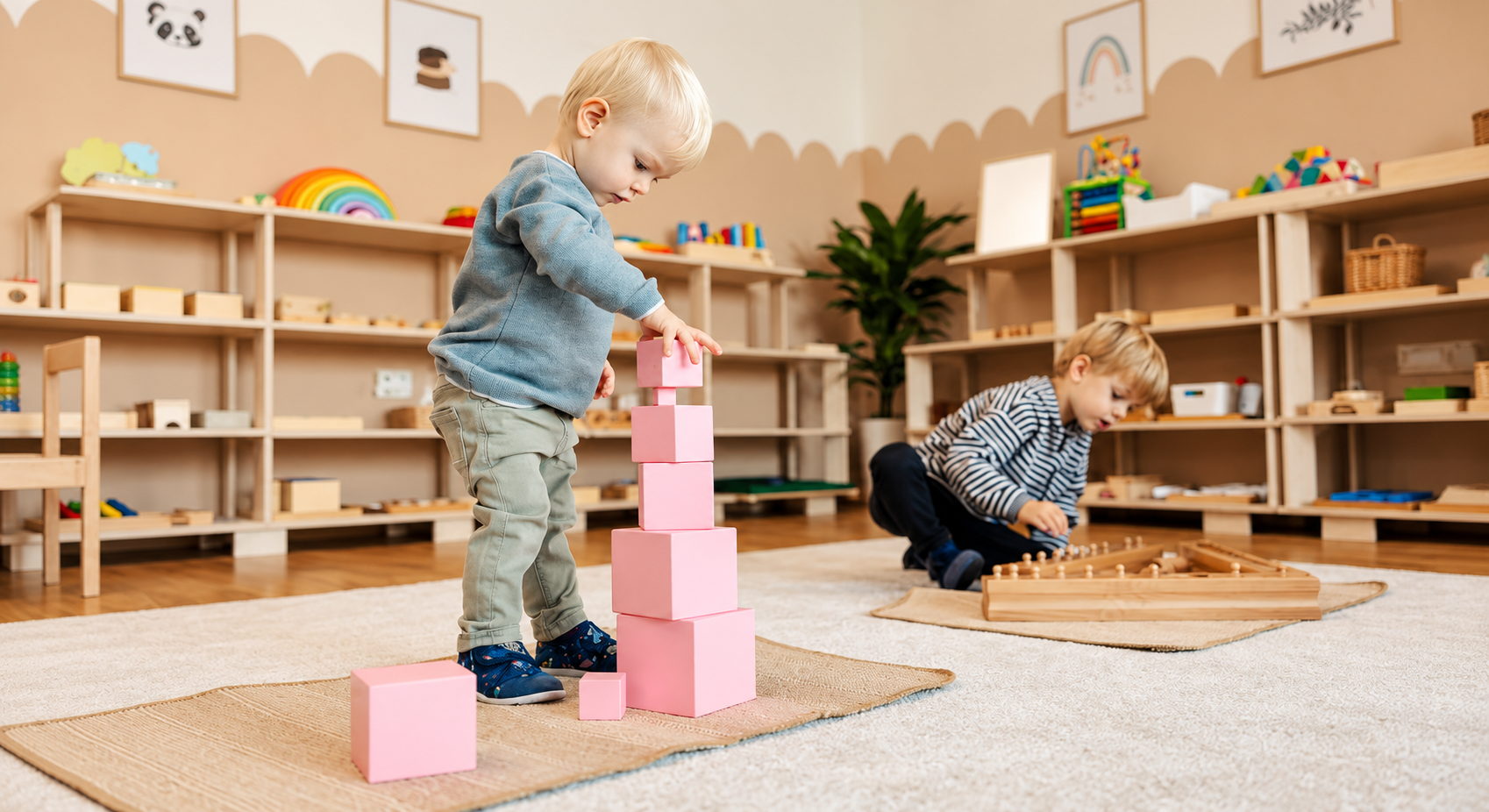
Safety, Durability and Materials
OEM/ODM Opportunities for Educational Toy Brands
Forestoy's Educational Wooden Toy Capabilities
Build Your Educational Toy Collection
Standards and Sources Referenced