China Wooden Toy Supplier vs. Factory: Which Is Better for B2B Buyers?
- Share
- publisher
- Forestoy
- Issue Time
- Aug 28,2026
Summary
China wooden toy supplier or factory direct? Both models have distinct strengths: trading companies excel at resource integration, product development coordination and full-service support, while factories control production cost, craftsmanship, quality execution and delivery. Compare price, MOQ, QC, lead time and compliance to choose the right sourcing model for your business.
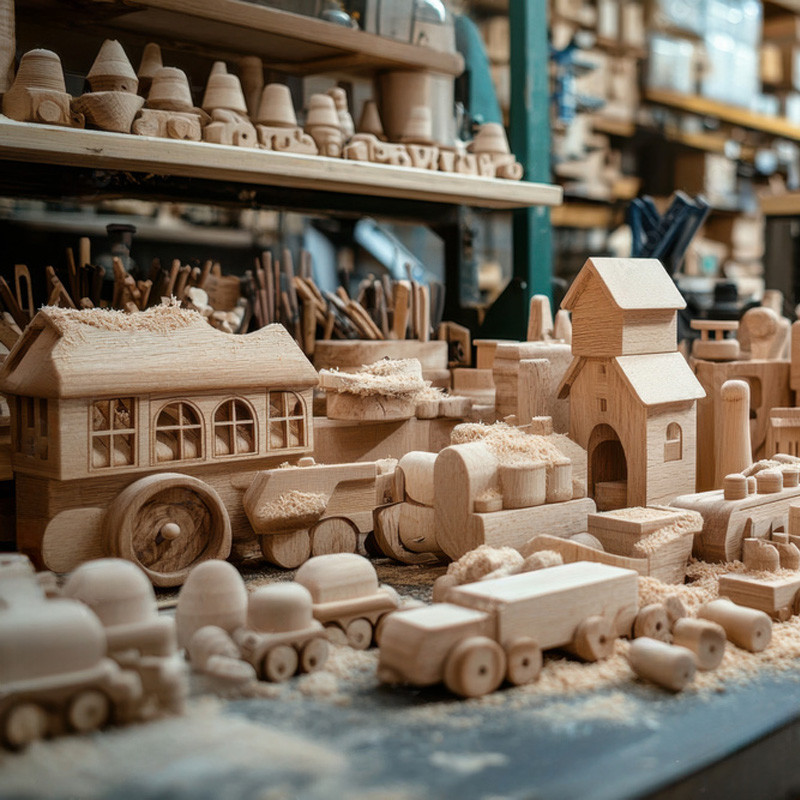
China's customs data tells a story every B2B buyer should study before placing a wooden toy order. Total toy exports fell 12.7% to USD 34.8 billion in 2025 — a third consecutive annual decline — with U.S.-bound shipments dropping 18.59% to USD 8.59 billion, the lowest in five years (General Administration of Customs of China, 2026). Yet within that shrinking market, wooden toys bucked the trend: exports under HS code 9503.00.6000 rose 5–8% to roughly USD 1.6–1.8 billion for the full year, driven by eco-demand and e-commerce (China Customs / UN Comtrade, 2026). When volumes fall and tariffs bite, choosing the right sourcing model — a wooden toy factory China or a professional trading-company supplier — becomes a strategic decision, not a preference. And that is the core question this guide answers: china wooden toy supplier or factory — which sourcing model is actually better for your business?
"Supplier" and "factory" are not synonyms. One is a role; the other is an asset. A wooden toy supplier china can be a manufacturer selling direct, a trading company reselling factory capacity, or an agent brokering between the two. A factory owns the machines, the workforce, the kilns and the test lab. A professional trading company brings deep knowledge of production processes and cost structures, integrates capacity across multiple factories, and often excels in product development coordination, communication, full-service support and marketing material design. Both models serve different buyer needs — and understanding which one fits your project is the purpose of this guide. For context, the profit rate of small and mid-sized Chinese toy exporters was already compressed from 10–15% to 8–12% in 2025 (industry survey, 2025), making the sourcing-model decision more consequential than ever.
Supplier vs. Factory: What Do the Terms Really Mean?
Before comparing advantages, define the players. In the China wooden toy trade, three distinct entities answer to "supplier":
- Factory-direct manufacturers — the actual production entity. They own tooling, woodworking lines, finishing workshops, in-house QC and export documentation teams. Forestoy, with 20+ years of continuous wooden toy production, is this type: a wooden toys factory china that also provides one-stop OEM/ODM service.
- Trading companies — commercial intermediaries that source from multiple factories and resell under their own trade name. They specialize in integrating factory resources, managing cross-factory product development, coordinating communication, and providing full-service support — from quality monitoring to marketing material design — that many factories are not structured to offer.
- Agents / sourcing offices — fee-based brokers who connect foreign buyers with factories, usually charging a commission or service fee.
The marketing language rarely helps: many trading companies present themselves as factories, and some factories register separate trading entities for export. That is why the practical test for B2B buyers is not the company name — it is whether the entity you pay can show you production evidence: factory license, audit reports, production lines on video, and test records. A genuine wooden toy supplier china who is also a factory can show you its own production lines in one call; a professional trading company should readily arrange partner-factory visits and provide consolidated documentation.
Buying from a Wooden Toy Factory in China
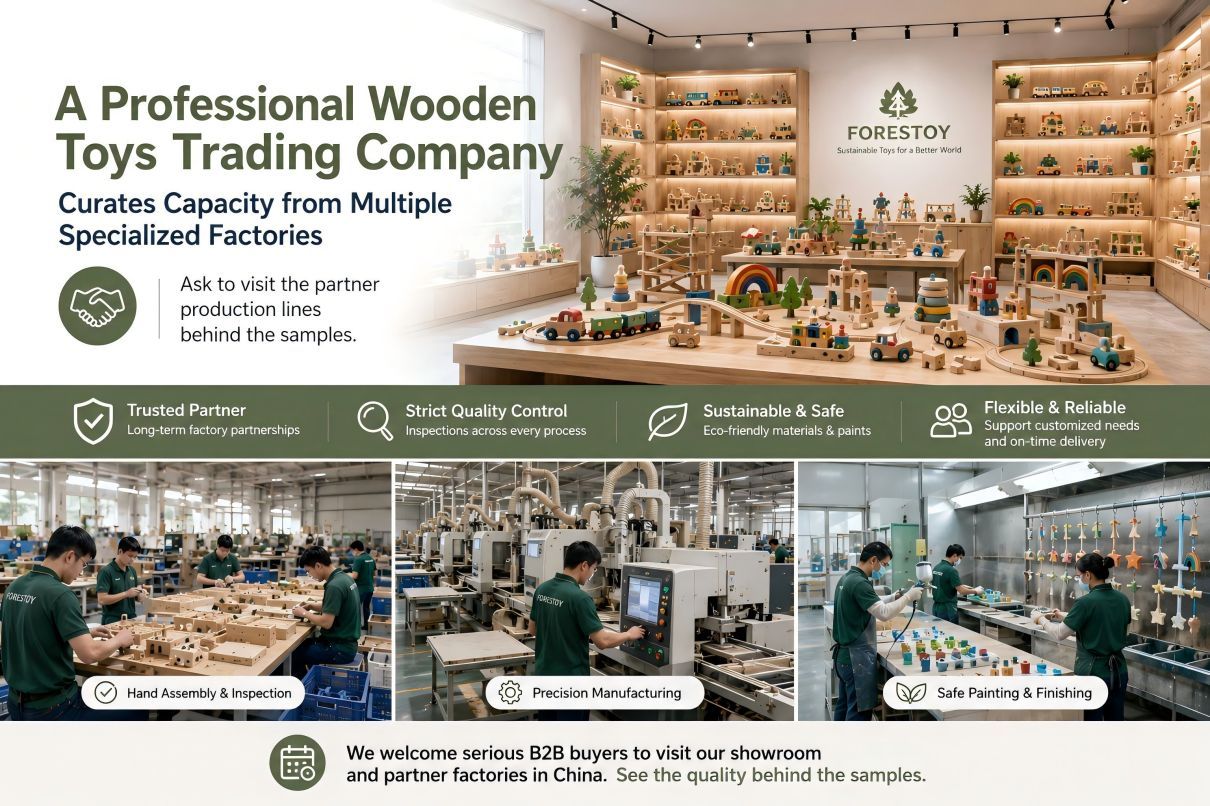
When you contract directly with a manufacturer, you buy capability, not resale. This is the model behind factory direct wooden toys china programs — and the one most global brands ultimately standardize on for china wooden toy factory direct sourcing, where production cost control, manufacturing process oversight and quality standard execution sit on the factory floor rather than in a coordination layer.
Advantages
- Production cost control. Direct access to the manufacturer's own cost structure — material, labor, finishing — with no intermediary layers. At current tariff pressure, controlling production cost at the source is a meaningful advantage.
- Manufacturing process control. You can audit the wooden toy factory manufacturing capacity: kiln-dried lumber sourcing, moisture control, paint batches, CNC precision. Process-level transparency that compliance claims can only promise, factories can prove.
- Quality standard execution. A factory's QC lab, AQL discipline and rework capability sit on its own shop floor. When defects are found, the party responsible for production is the party you contracted — direct accountability for quality outcomes.
- Delivery time control. The factory owns its production schedule. Sample lead times, bulk production slots and finishing queues are managed in-house, giving you real — not estimated — timeline commitments.
Potential Limitations
- Higher MOQ reality. Direct factories set MOQs that reflect real tooling and setup costs. The good news: serious manufacturers offer flexible MOQ and lead time options for customized orders, so this is negotiable — but not imaginary.
- Fewer SKUs to cherry-pick. A single factory cannot carry the breadth of a trading company that aggregates 20 factories. If you want one mixed container from 15 factories, a trader has the edge.
- Language and logistics overhead. You manage directly with engineers and export teams. With a disciplined partner this is an advantage; with a poorly run factory it can be exhausting.
Buying from a Wooden Toy Supplier in China
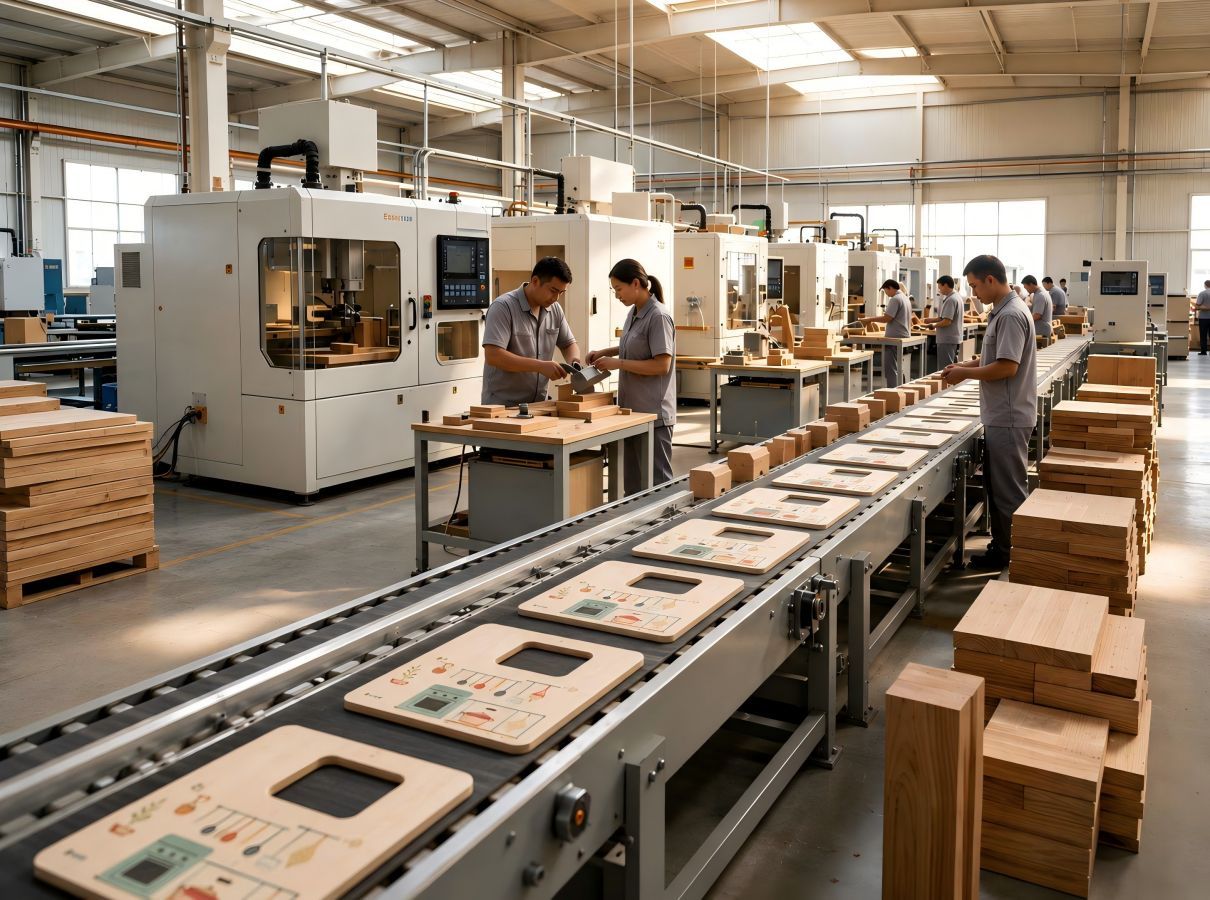
Not every buyer should go factory-direct. Professional trading companies and sourcing partners — broadly, wooden toy suppliers china without their own factories — solve a different set of problems and often outperform factories in areas where factories are structurally weak.
Advantages
- Production process and cost knowledge. A professional trading company that has worked across multiple factories develops a deep, cross-referenced understanding of production workflows, cost structures and pricing benchmarks. They know which factory excels at which process — and can route your order to the right partner without you needing to audit 20 factories yourself.
- Factory resource integration. One purchase order can mix educational toys, games, and kids' furniture from different specialized producers — each chosen for what they do best. This integrated sourcing is something no single factory can match, and it is genuinely valuable for wholesalers building category breadth or first-time importers testing a market.
- Product development coordination. Many experienced trading companies run dedicated product development teams that coordinate design, prototyping and engineering across partner factories. They can manage a multi-SKU brand launch — briefing factories, consolidating samples, standardizing finishes across suppliers — with a project management discipline that small and mid-sized factories often lack.
- Communication and coordination. Trading companies serve as a dedicated account management layer: bilingual project managers, consolidated reporting across factories, and a single point of contact for multiple production lines. For buyers with limited China-side resources, this coordination layer is not a markup — it is a capability.
- Full-service support. Professional suppliers provide end-to-end service: quality monitoring across partner factories, consolidated export documentation, container loading supervision, and — critically — marketing material design support including product photography, packaging artwork, e-commerce listing copy and catalog development. Many factories are not structured to deliver this level of commercial support.
- Low-volume entry. Traders aggregate demand across many buyers, so you can start with smaller quantities while testing demand before committing to factory-level MOQs.
Potential Limitations
- Indirect process visibility. The supplier coordinates QC across partner factories, but you see the final inspection report rather than the in-process checkpoints on the shop floor. A professional supplier will arrange factory visits or live video audits on request — but the access is mediated, not direct.
- Production schedule dependency. A trading company does not own the production lines. If a partner factory's schedule shifts, the supplier must renegotiate — it cannot simply reprioritize its own shop floor. Good suppliers manage this with multi-factory contingency; weaker ones pass the delay downstream.
- Certificate ownership. A supplier holds the certificates of its partner factories, not its own chain-of-custody. For most buyers this is sufficient; for brands requiring end-to-end traceability (FSC chain-of-custody, B-Corp audits), the factory-direct model provides a stronger documentary chain.
Factory Direct vs. Trading Company: Key Differences
The cleanest way to frame the decision is to compare a genuine wooden toy factory China against a professional trading-company supplier on the dimensions that actually affect your P&L and operations. Each model has genuine strengths — the goal is to match the model to your project, not to declare a universal winner.
| Dimension | Factory Direct | Trading Company |
|---|---|---|
| Cost structure | Direct production cost — material, labor, finishing | Coordinates across factories; cost reflects sourcing efficiency, not just a single factory's overhead |
| MOQ | Real, but negotiable with flexible options | Lower — aggregated across buyers and factories |
| Product development | In-house R&D floor, direct prototyping | Cross-factory development coordination, multi-SKU project management |
| Quality control | In-process + lab testing + pre-shipment on own floor | Cross-factory QC monitoring + consolidated inspection reports |
| Certifications | Owns certificates (FSC, EN71, ASTM, ISO) | Consolidates partner-factory certificates; broader certified catalog |
| Communication | Direct with engineers and QC | Dedicated account management; bilingual coordination across factories |
| Assortment | Its own categories and designs | Wide, multi-factory catalog — each factory's best capability |
| Service scope | Production-focused; limited commercial support | Full-service: marketing materials, packaging design, e-commerce listings |
| Delivery control | Owns production schedule; direct priority control | Coordinates partner schedules; multi-factory contingency |
8 Factors B2B Buyers Should Compare
For a structured decision, score every candidate — factory or supplier — against these eight factors. Weight them according to your model: a brand building a custom line weights product development and quality control highest; a discount retailer weights price and MOQ.
1. Price
Get the breakdown, not just the number. A factory quote covers material, labor, finishing and testing against its own cost structure; a trading company quote reflects its sourcing efficiency across partner factories — it may secure better material pricing through volume aggregation, or route production to a factory with lower overhead for your specific product type. In 2025, with Chinese toy SME profit margins squeezed to 8–12%, the real question is not "who is cheaper" but "which model delivers the right cost-to-service ratio for your order size and complexity."
2. MOQ
Factories need MOQs that amortize tooling and setup; traders aggregate. If you are launching a test SKU, a supplier's low MOQ is genuinely valuable. If you plan multi-year brand programs, a factory's flexible MOQ for customized orders with clear break-point pricing is the better long-term structure.
3. Product Development
Can they engineer a new product, or only copy an existing one? A factory with an R&D floor can iterate your concept through drawings, prototypes and pre-production samples — direct and fast. A professional trading company can coordinate development across multiple specialized factories, manage multi-SKU brand launches, and bring cross-category design experience that a single factory may not have. Ask for the development workflow, tooling capability, and how many new products they released last year — then match the answer to your project scope.
4. Customization
Customization has degrees: packaging and labeling (almost everyone), finish and color (many), and structural/design changes (factories only). Define which degree your project needs before comparing, or you will compare apples to oranges.
5. Quality Control
Review the wooden toy quality control system in place: in-process inspection, AQL sampling levels, lab equipment, and rework procedures. Factory-direct buyers can audit this system live; supplier buyers typically see only the final inspection report.
6. Lead Time
Wood is a material that cannot be rushed — drying, finishing and curing have physical minimums. A factory quotes 45–60 days for bulk production from its own schedule; a trading company coordinates across partner factories, which can mean longer consolidated timelines for mixed orders but also multi-factory parallel production for large programs. Verify sample lead times (7–15 days is normal) and ask for transparent scheduling — regardless of model.
7. Communication
Test responsiveness before ordering: time-to-first-answer, technical depth of replies, willingness to share documentation. Factory-direct gives you direct access to engineers — efficient for technical resolution. A trading company provides dedicated account management with bilingual coordination — efficient for multi-factory programs where consolidated reporting matters. Match the communication model to your team's capabilities and project complexity.
8. Compliance
Ask which standards they actually test to (EN 71, ASTM F963, ISO 8124, CPSIA), which labs they use (in-house, SGS, TÜV, BV, Intertek), and whether FSC certified wooden toys and ISO 14001 processes are in place. Then request the certificates — china wooden toys factory supplier claims should end in documents with verifiable factory names and test-lab references.
How Forestoy Combines Manufacturing and B2B Support
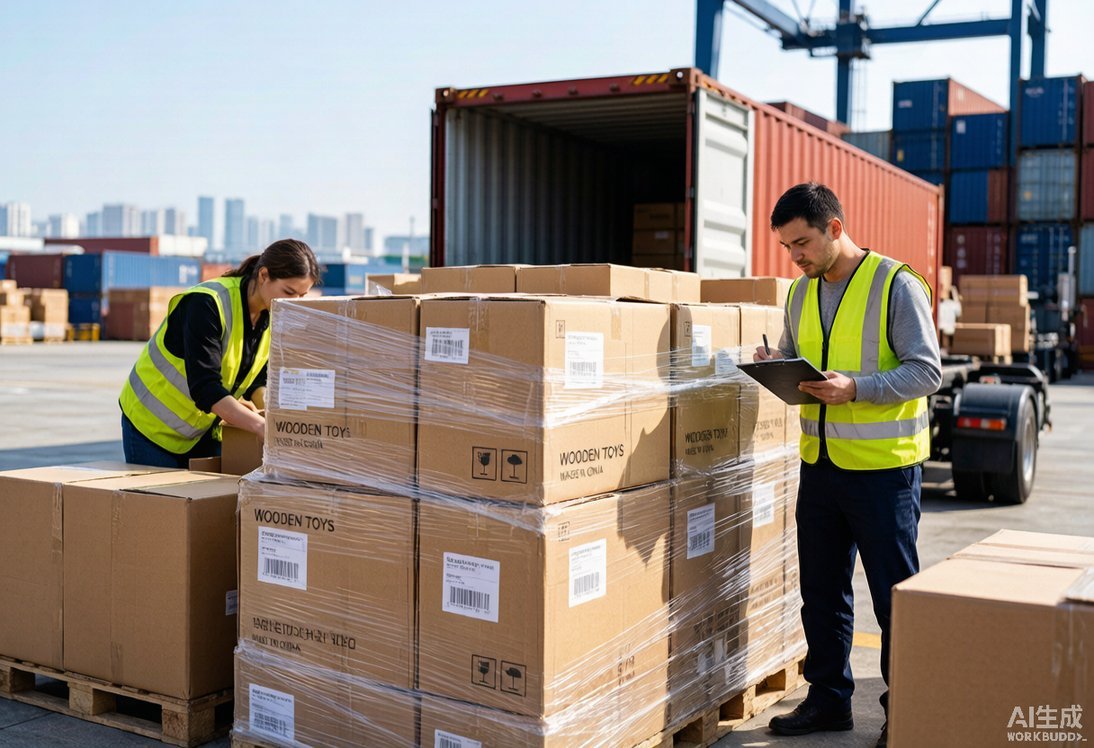
Forestoy is a factory first — 20+ years of continuous wooden toy manufacturing, supplying 100+ global brand clients, producing from our own workshops with a monthly capacity of roughly 200,000 pieces. But it is also a B2B partner designed for the exact buyer dilemma described above:
- One-stop OEM/ODM across the full wooden toys range — educational toys, pretend play, games, music toys, kids' furniture and Montessori-inspired products — with an in-house wooden toy design and development team that delivers factory depth without multi-factory complexity.
- Certified compliance: FSC™ chain of custody (certificate C131173), ISO 14001 environmental management, ISO 45001 occupational safety, with EN 71 / ASTM F963 / ISO 8124 / CPSIA testing support from in-house and third-party labs.
- Transparent QC: in-process inspection plus AQL 2.5/4.0 sampling, and three rounds of free inspection built into every order — the kind of process evidence that lets buyers audit us, not take our word.
- B2B service depth: free photography for e-commerce sellers, mail-order packaging design, flexible MOQ for customized orders, and direct communication with engineers and QC — combining factory production control with the service and coordination capabilities buyers expect from a professional supplier.
 Wooden GamesBest sellers straight from factory production
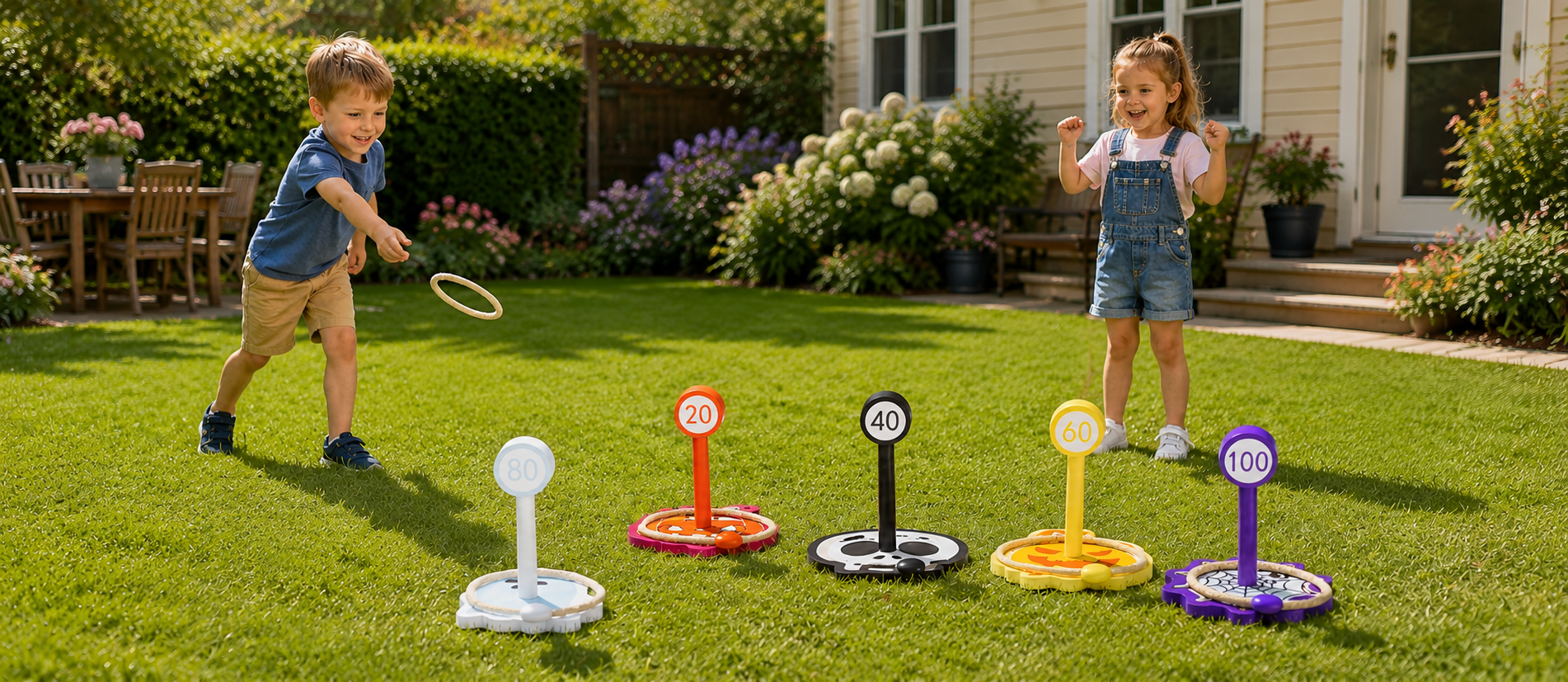 Wooden Outdoor ToysDurable outdoor play, factory-direct pricing
 Wooden Music ToysCustomizable sound and design for your brand
If you are still mapping the territory, our series covers the surrounding decisions: how to choose a reliable wooden toy manufacturer in China, the 10 questions to ask a wooden toy manufacturer before ordering, a practical wholesale buyer's guide to MOQ, pricing and quality, the step-by-step sourcing playbook, a 12-point factory checklist, and a supplier comparison scorecard.
Choosing the Right Sourcing Model
Decide in four steps:
- Define your program — one-off test order, multi-SKU brand launch, or ongoing supply? Deep engineering projects benefit from factory-direct; broad assortment builds and mixed-container orders benefit from a professional trading company.
- Define your service needs — do you need marketing materials, packaging design, e-commerce listing support, and multi-factory coordination? If yes, a professional trading company may serve you better than a factory focused on production. If you need in-process QC audits and direct engineering access, factory-direct has the edge.
- Audit before you commit — regardless of model, request factory license, audit reports, live video tours and test certificates. A professional trading company should readily arrange partner-factory visits; a factory should pass all checks in one call.
- Consider both — many experienced B2B buyers maintain relationships with both a factory partner (for core product lines where production control matters) and a trading company (for breadth, mixed containers, new-category testing and commercial service support). The two models are complementary, not exclusive.
The right china wooden toy supplier — whether a wooden toy factories china manufacturer or a professional trading partner — is the one whose strengths match your project's requirements. Define your needs honestly, audit candidates rigorously, and you will find that both models have an important role in China's wooden toy supply chain.
Compare Your Current Supplier Model Against a Direct Manufacturing Partnership
Send Forestoy your product list or target specs and we will respond with factory-direct pricing, MOQ and lead time options — alongside the factory audit evidence you need for a fair comparison.
- Factory license, audit reports & certification documents (FSC™ C131173, ISO 14001/45001)
- Free samples from our production line, freight covered on qualifying projects
- Live video factory tour and direct engineer access — factory-direct, with full B2B service
- Flexible MOQ and a response within 12 working hours
Sources:
General Administration of Customs of China (GACC), full-year 2025 toy export statistics (published Feb 2026): total toy exports USD 34.81B, −12.7% YoY; U.S. exports USD 8.59B, −18.59%; EU −13.23%; general trade share 66.2%; China Toy Association 2025 Export White Paper. Wooden toy export data under HS code 9503.00.6000: 2025 Jan–Sep exports USD 1.25–1.4B, +5–8% YoY, full-year projection USD 1.6–1.8B with 4–6% growth expected in 2026; U.S. ~30% share (USD 400–450M), EU ~40% share (USD 500–550M); 70% of global buyers requiring FSC certification with 8–10% price premiums; SME exporter profit margins 8–12% (China Customs / UN Comtrade / 2025 wooden toy export report, Kidcotoys). CPSC recall data 2025: 376 recalls and safety warnings, Chinese-origin products ~66% share. EU Safety Gate Q1–Q3 2025: 3,608 alerts, toys the largest category at 30%. ISO 8124 / EN 71 / ASTM F963 / CPSIA standards documentation. Forestoy company data from official website (forestoy.com), 2026.